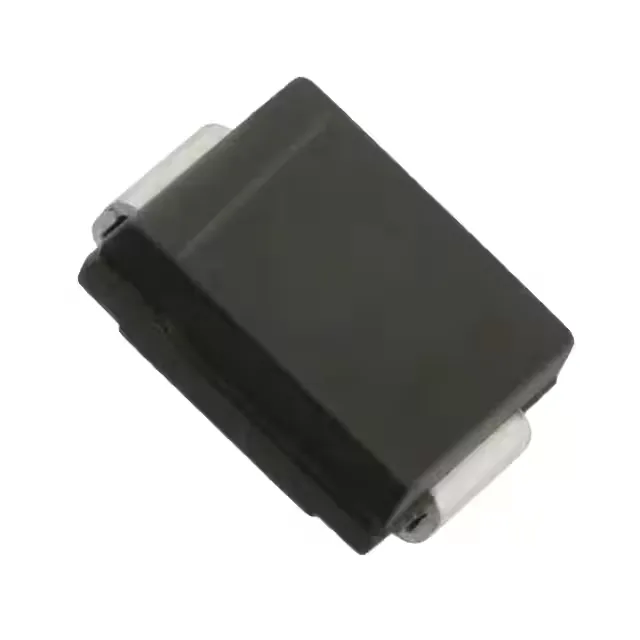
The SMCJ58A-13: For a 58V line, the 93.6V maximum clamping voltage means the protected circuit sees no more than that during the pulse, which keeps downstream components inside their avalanche rating.
Protection window — standoff, breakdown, clamp
The reverse standoff voltage is 58V — the rail runs at or below this in normal operation and the TVS draws negligible leakage. Breakdown starts at 64.4V minimum, so the device does not conduct until the transient pushes past that threshold. Clamping maxes at 93.6V at the rated 16A peak pulse current, giving a 29.2V window between the rail and the clamp ceiling. That gap is tight enough for most 60V-rated downstream silicon to survive a surge.
Package and board-fit — DO-214AB SMC
The DO-214AB (SMC) package is a standard surface-mount footprint for this power class. The 1500W rating demands a copper pad area on the PCB to sink the pulse heat — the junction-to-ambient thermal path runs through the solder joint and the board copper, not through a heatsink. The -55°C to 150°C junction temperature range covers both cold-start and under-hood ambient without derating the pulse power at the high end.
Where it fits — and where it does not
This is a single-channel unidirectional TVS, so it protects one signal or DC power line against positive-going transients relative to ground. The datasheet explicitly lists 'Power Line Protection: No' — that means it is not rated for AC mains or high-energy industrial power bus clamping. It belongs on DC supply rails, I/O lines, or communication ports where the transient energy stays within the 1500W 10/1000µs envelope.