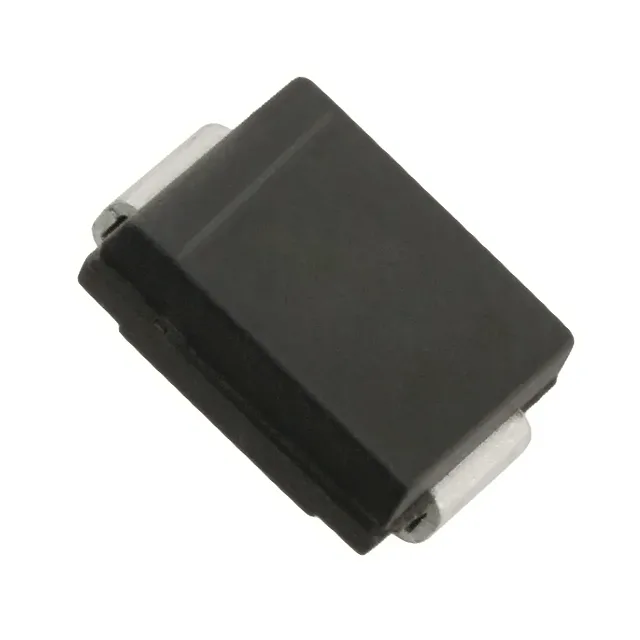
Automotive-grade 1500W surge clamp — the qualification that matters
The SMCJ30CAQ-13-F: Its AEC-Q101 qualification is the defining spec for this part — capable is not qualified, and the OEM auditor will ask for PPAP documentation. This grade means the device has passed the full suite of automotive reliability stress tests (temperature cycling, high-temperature reverse bias, moisture sensitivity) and is released with production-part-approval-process (PPAP) support. The -55°C to 150°C junction temperature range covers under-hood and engine-bay ambient conditions with margin: a 125°C ambient still leaves 25°C headroom before the absolute maximum junction is reached, critical for sustained clamp events in high-temperature environments.
Protection window: breakdown, clamping, and peak current
The minimum breakdown voltage is 33.3V, ensuring the device does not conduct at the 30V standoff rail — the protection window starts above the nominal supply, not at it. A downstream 50V-rated capacitor or IC has 1.6V of margin above the clamp; a 40V-rated part does not. Bidirectional (single-channel) construction means the same device clips positive and negative transients symmetrically — no polarity orientation needed on the board, which simplifies placement in AC-coupled or dual-polarity signal paths.
Package, footprint, and board-level integration
The surface-mount footprint mates with a standard SMC land pattern — the copper pad area under the cathode tab sets the thermal resistance for sustained power dissipation. No power-line protection feature is claimed (Power Line Protection: No) — this is a general-purpose transient suppressor for signal and low-power supply rails, not a primary mains surge protector.