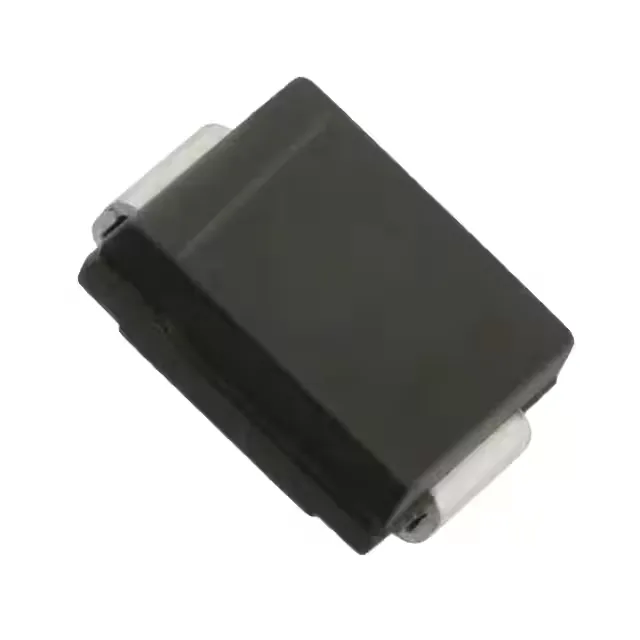
1500W bidirectional TVS — what the voltage stack means for your rail
The SMCJ15CA-13-F: If your 12V or 15V rail stays below the standoff in normal operation, this part stays invisible until a transient hits — then it clamps the spike to 24.4V, protecting downstream silicon rated for, say, 30V abs-max. Bidirectional means a single device protects both positive and negative transients — useful on AC-coupled data lines or bipolar supplies where you would otherwise need two unidirectional diodes back-to-back. The DO-214AB (SMC) package is the larger body in the SMCJ family, sized to dissipate that 1500W pulse without exceeding the 150°C junction temperature limit.
Active lifecycle and sourcing posture
The base product number SMCJ15 covers the unidirectional (SMCJ15A) and bidirectional (SMCJ15CA) variants in the same DO-214AB footprint. If your BOM calls for the bidirectional version, the -13-F suffix denotes the tape-and-reel packaging format — the silicon and electrical characteristics are identical to the bulk-tube variant.
Package and board-fit note for the DO-214AB (SMC)
Surface-mount DO-214AB (SMC) package — the larger of the common DO-214 family (SMA, SMB, SMC). The body dimensions (approx 7.1 x 6.2 mm) and the cathode band (for unidirectional) or no band (bidirectional) are standard across the SMCJ series. The copper pad area under the package on the PCB sets the thermal impedance for pulse dissipation; a solid copper pour on the top layer under the part, connected to the inner ground plane with vias, pulls heat away during the 10/1000µs pulse. The 150°C limit is the silicon junction, not the case — derating for ambient temperature above 25°C follows the standard power-derating curve in the datasheet.