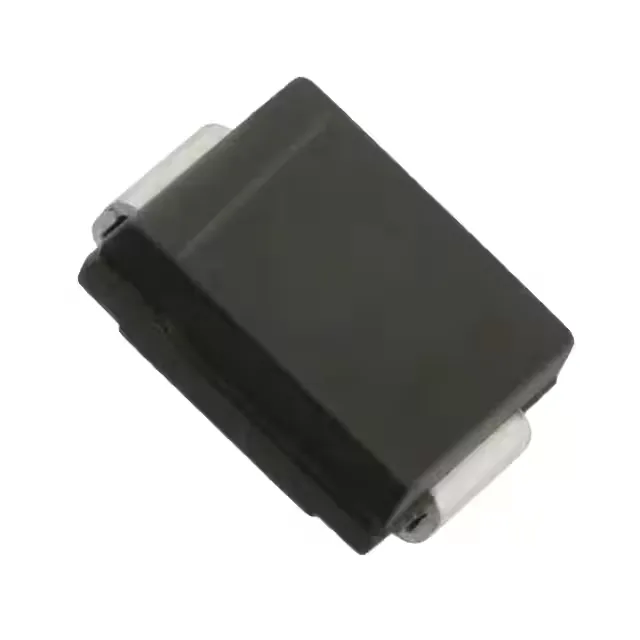
1.5 kW bidirectional TVS for 130 V rails
The SMCJ130CA-13-F: The 130 V reverse standoff voltage (V_RWM) means it sits across a 130 V DC rail without conducting appreciable leakage; the 209 V clamping voltage (V_C) at the 7.2 A peak pulse current (I_PP) defines the voltage the protected circuit must survive during the event. The bidirectional configuration uses a single device for protection on AC lines or DC rails where the signal swings above and below ground.
Clamping voltage and peak current: the protection envelope
The 209 V clamping voltage at 7.2 A is the maximum voltage the TVS allows across its terminals during a 10/1000 µs surge. Downstream components — DC-DC converters, CMOS logic, or sensitive transceivers — must have an absolute-maximum rating above 209 V to survive the clamp event without secondary failure. The 1.5 kW peak pulse rating is the power the device absorbs during that surge. For a 130 V rail, the TVS triggers at the 144 V minimum breakdown voltage (V_BR), shunting the surge current away from the protected load. The 1500 W rating at 25°C derates with ambient temperature per the datasheet curve; at 85°C ambient the peak pulse power capability drops to roughly 75% of the 25°C value. The DO-214AB SMC package's copper pad area on the PCB sets the thermal impedance for the 1.5 kW pulse. A 2 oz copper pour under the cathode tab improves heat spreading and allows the TVS to absorb repetitive surges without exceeding the 150°C junction limit.
Sourcing and lifecycle posture
The base product number SMCJ130 covers the full family; the CA suffix indicates bidirectional polarity and the -13-F denotes the Tape & Reel packaging option. No official pin-compatible second source is listed on the record, though the DO-214AB footprint is shared by TVS diodes from multiple manufacturers — a parametric cross-reference can be evaluated at RFQ.