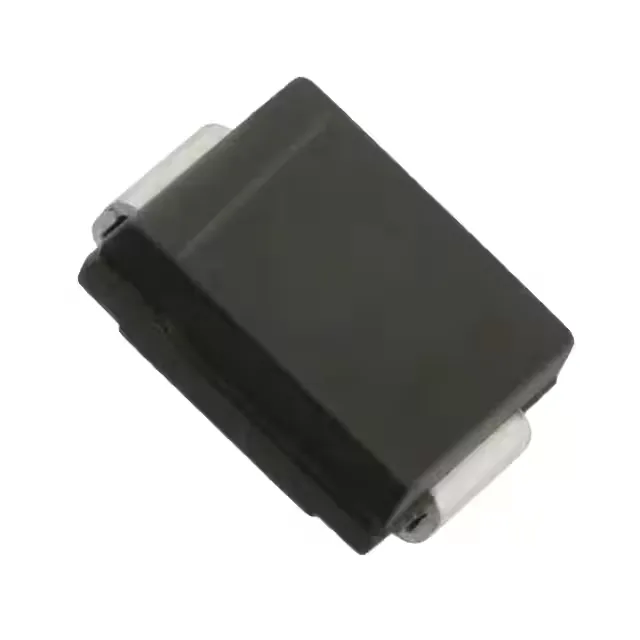
Surge protection for 12V rails — what the ratings mean on the bench
The SMCJ12A-13-F: The 12V reverse standoff voltage (V_RWM) means it sits across the supply without conducting during normal operation — it only starts to avalanche when the line exceeds 13.3V (the minimum breakdown voltage). At that point it clamps the surge to 19.9V maximum, shunting up to 75.3A of peak pulse current (10/1000µs waveform) away from the downstream circuitry. The 1500W rating is the peak pulse power dissipation at the 10/1000µs waveform — enough for most industrial transient events like inductive kickback or ESD strikes on a 12V sensor bus. Because the part has no power line protection (it is not rated for AC mains surges), it is best suited for DC power inputs, signal lines, or low-voltage data interfaces where the energy is contained.
Package and rework — DO-214AB (SMC) on the bench
The SMCJ12A-13-F comes in a DO-214AB (SMC) surface-mount package, a standard footprint for TVS diodes in the 1500W class. The package body is large enough to handle the thermal pulse without lifting pads during reflow, and the cathode band is clearly marked — no guessing where pin 1 is. For rework, a hot-air station at 300°C with a fine nozzle lifts the part cleanly; the copper pad on the board should have a thermal relief to avoid tombstoning during wave solder.
It is a standard catalog part from Diodes Incorporated, widely used across general-purpose protection designs.