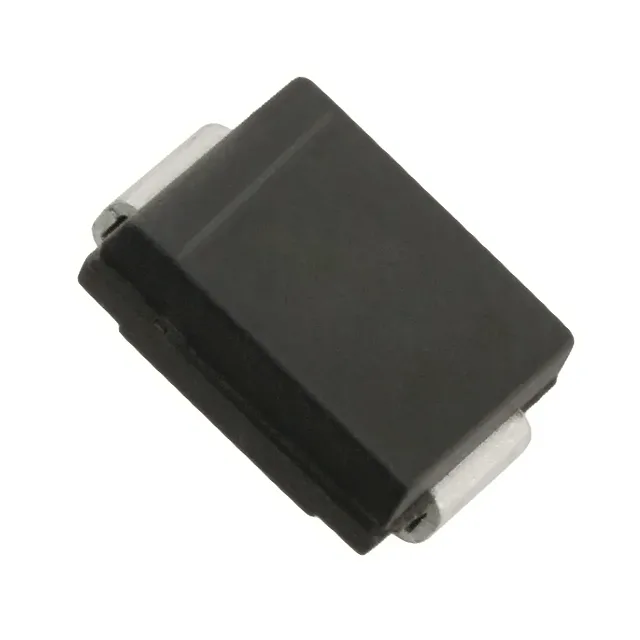
1500 W peak pulse — what that clamp rating means on a real board
The SMCJ100CA-13-F: That 1500 W rating is the energy-handling limit for a single pulse — the part absorbs the transient and clamps the line before the downstream IC sees the overvoltage. For a 100 V nominal rail, the 111 V minimum breakdown means it starts conducting just above the normal operating voltage, so it stays out of the way during steady-state but fires early enough to protect a 120 V-rated switcher front end.
Bidirectional, single channel — one component guards a differential pair
With one bidirectional channel, this single SMC package protects both polarities of a signal pair or a DC rail against positive and negative transients. The 100 V reverse standoff is the maximum DC or AC peak voltage the TVS can hold without conducting leakage current — match this to your nominal rail voltage. The DO-214AB (SMC) package is the industry-standard footprint for 1500 W TVS diodes — it mates with the same copper-land pattern used by Littelfuse, Vishay, and ST parts in this power class. Surface-mount assembly keeps the lead inductance low, which matters for the sub-microsecond rise time of an ESD or lightning surge.
The operating temperature range spans -55°C to +150°C (junction), covering industrial, telecom, and under-hood automotive ambient conditions. The wide junction-temperature window means derating for high ambient is straightforward — the 1500 W rating is at 25°C; derate linearly to zero at 150°C per the standard TVS derating curve.