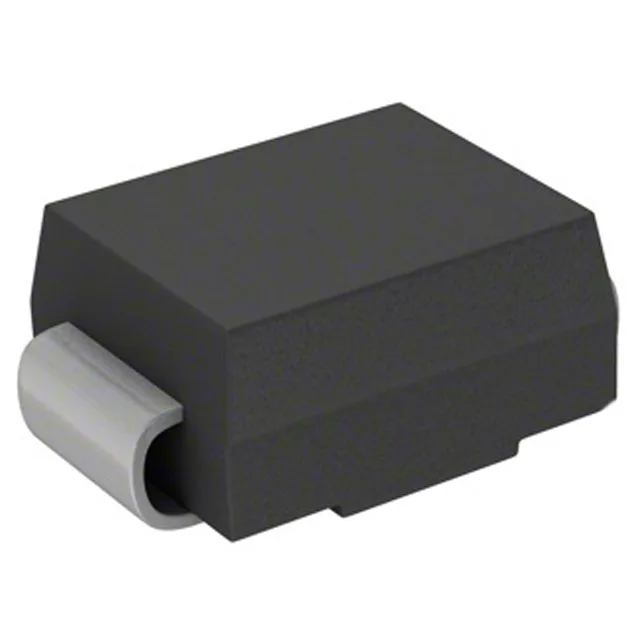
600 W peak pulse, 51 V standoff — what the ratings mean on the board
The SMBJ51CA-13-F: The 82.4 V clamping voltage at the 7.3 A peak pulse current (10/1000 µs waveform) means a downstream 80 V-rated DC-DC converter or driver IC sees a spike held below its abs-max — the TVS absorbs the surge before the regulator's input filter caps charge up. On a 48 V telecom supply or a 51 V battery line, it is sized to clip surges without conducting during normal ripple.
DO-214AA SMB — field-swappable with basic kit
Surface-mount in a DO-214AA (SMB) package — the same footprint as the common SMBJ and P4SMA series. Two-pad layout, polarity marked on the body (cathode band for the Zener direction; bidirectional means no orientation worry on the board). Reflow profile matches standard 260 °C peak Pb-free solder. No special handling beyond basic ESD precautions — swap it on site with a hot-air station or a soldering iron if the pads are accessible. The wide temp range means the leakage current at 85 °C ambient is still within the datasheet's typical curve; no derating needed for most 48 V bus applications up to 125 °C.
Active production — no last-time-buy pressure
General-purpose application class per the category — not automotive-qualified (no AEC-Q101 listed), but the -55 °C to 150 °C range suits industrial and commercial equipment. Power line protection is marked No, meaning it is intended for signal or low-voltage DC bus clamping, not AC mains surge suppression.