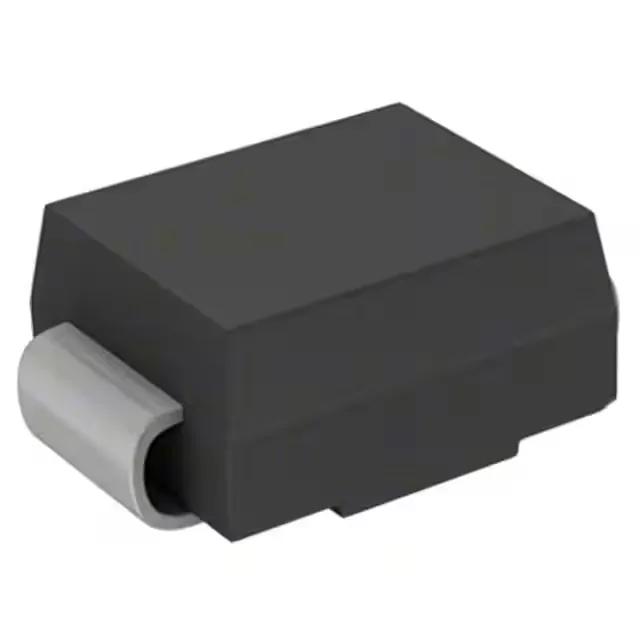
Active production — a straightforward TVS for 6V rails
The SMAJ6.0A-13-F: The 6 V reverse standoff voltage means it sits across a 5 V or 6 V rail without conducting in normal operation, only turning on when the line sees a surge above the 6.67 V minimum breakdown threshold.
What the clamping numbers mean on the bench
When a transient hits, the diode breaks down at 6.67 V minimum and clamps the voltage to 10.3 V maximum while shunting 38.8 A to ground. For a 6 V rail powering a microcontroller or sensor interface, that 10.3 V ceiling is the voltage the downstream components see — if the rail's absolute maximum is 12 V, this diode buys enough margin to survive a nearby lightning strike or inductive kickback. The 400 W peak pulse rating is the energy-handling spec at the 10/1000 µs test waveform — shorter pulses (like 8/20 µs) allow higher peak current, but the 400 W figure is the conservative anchor for design.
The SMA footprint fits a standard 2-pin SOD-128 or SMB pad if the board already has that land pattern; verify the pad-to-pad clearance matches the SMA body width (2.90 mm typical). No power line protection flag is set — this is a signal-rail TVS, not designed for AC mains or high-energy power bus clamping. For a 6 VDC control rail, sensor supply, or communication line, it is a good fit.