Protection window for a 5V rail
The SMAJ5.0A-13-F is a Zener-type TVS diode — the clamping mechanism that shunts transient energy away from sensitive downstream silicon. Its 5V reverse standoff means the rail can sit at 5V nominal without the diode conducting leakage; the breakdown triggers at 6.4V min, and the clamp holds at 9.2V max while passing 43.5A of peak pulse current. That 9.2V ceiling is what the protected IC actually sees during a surge — for a 5V logic or power rail, the margin between the clamp and the IC's abs-max rating is the safety gap. A shorter pulse (8/20µs) lets the diode absorb more peak current; the 43.5A figure is the limit at the 10/1000µs condition. This is a general-purpose protection device, not a power-line-rated suppressor — it guards signal and low-power supply inputs, not mains or high-current rails.
Package and rework profile
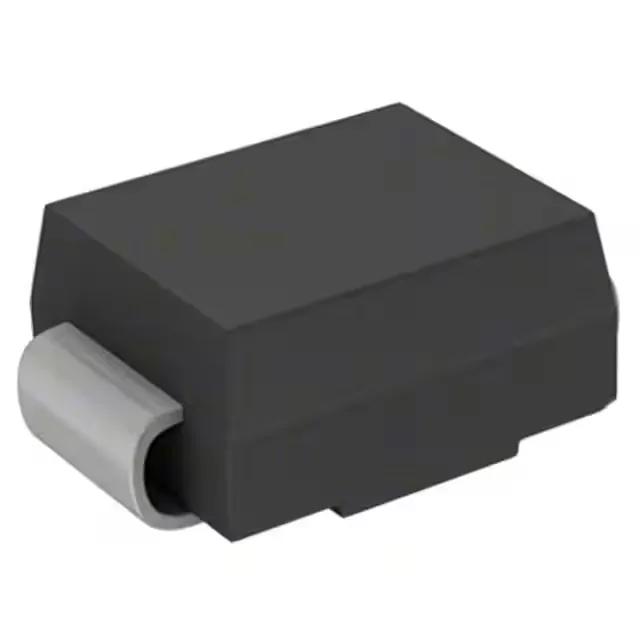
Housed in a DO-214AC SMA package, the SMAJ5.0A-13-F is a surface-mount device with a low-profile body that suits automated pick-and-place and reflow. The SMA footprint is a standard JEDEC outline — the same land pattern serves many TVS and Schottky diodes in this package class. For rework, a hot-air profile at 260°C peak (typical lead-free reflow) clears the solder without damaging the junction; the -55°C to 150°C operating junction range means the die tolerates the thermal cycle of soldering and field temperature swings in outdoor or industrial enclosures.
Single-channel, polarity-aware
This is a unidirectional device — it clamps only one polarity (positive transients above breakdown, forward-conducting negative spikes like a Schottky). For a 5V rail that never sees reverse voltage, the unidirectional part is the correct fit; a bidirectional version would be needed for AC-coupled signal lines or rails that swing below ground. The single channel means one diode per protected line — no shared clamping between multiple traces.