What the 400 W peak pulse rating means on a 48 V rail
The SMAJ48CA-13-F: At a 48 V reverse standoff voltage, the clamping voltage holds at 77.4 V max when the 5.2 A peak pulse current hits. That clamp ceiling tells you the downstream silicon sees less than 78 V during a surge — well within the abs-max of a 60 V or 80 V bus capacitor or a downstream regulator's input rating. The bidirectional channel means a single device protects both polarities on a signal or power line — handy on AC-coupled data lines or on a 48 V rail where the return path can swing negative during a fault. No need for two back-to-back unidirectional parts.
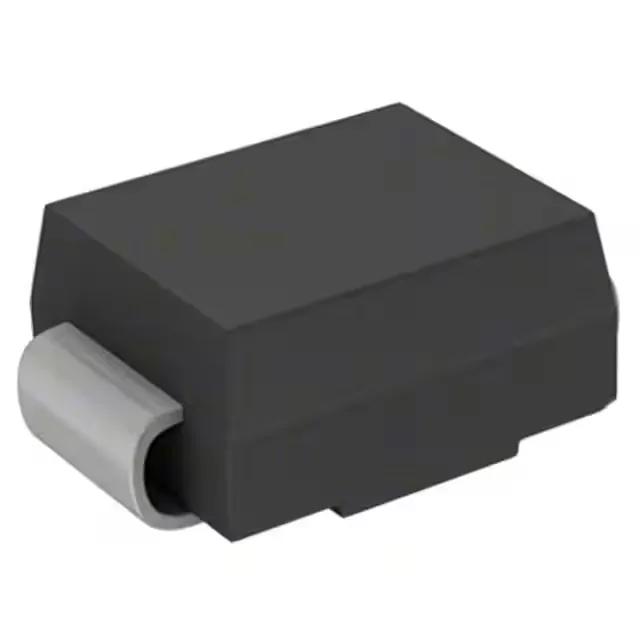
Housed in the DO-214AC (SMA) package, the SMAJ48CA-13-F is a surface-mount device with a low-profile body that reflows on standard FR-4 with a 260 °C peak profile. The SMA footprint is common across the SMAJ family — the same pad layout accepts 5 V, 12 V, or 48 V variants, so a single PCB land pattern covers the whole voltage range. The 400 W rating is derated above 25 °C per the standard thermal derating curve; at 125 °C ambient the effective pulse power drops to roughly 200 W.