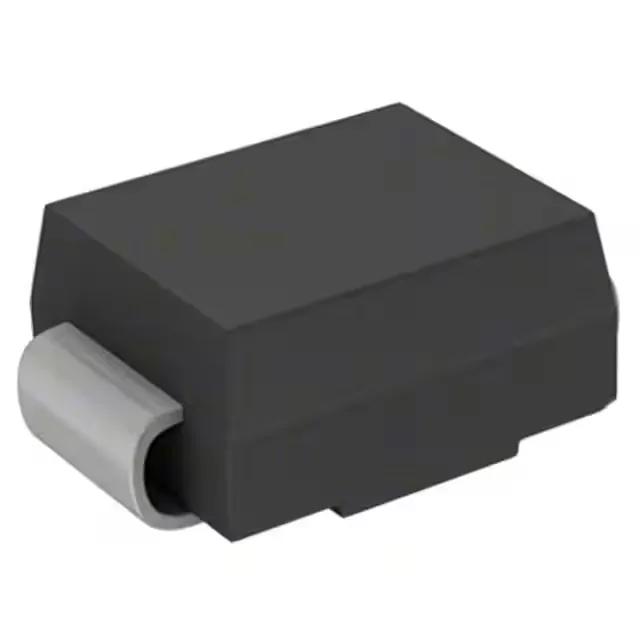
Clamping and breakdown — what the ratings mean for your rail
The SMAJ20A-13: This is the maximum continuous DC voltage the device can withstand without conducting — a 20 V rail or a 12 V system with transients up to 20 V stays below the leakage threshold. The 32.4 V clamp means a 24 V nominal rail sees the TVS hold the surge to about 35% above the rail — the downstream components must survive that peak for the pulse duration. The 12.3 A peak current is the maximum the device can shunt; if the source impedance is lower, the TVS may exceed its peak current rating and fail short.
DO-214AC SMA — board-fit and thermal note
This is a standard footprint shared across the SMAJ series — the cathode tab on the larger pad carries the heat into the PCB copper pour. The junction temperature limit of 150°C means the 400 W pulse derates above 25°C ambient — at 85°C the peak pulse power is roughly 60% of the 25°C rating, per the standard derating curve for this package family.
General-purpose protection — where it fits
The SMAJ20A-13 is classified for general-purpose applications — it is not a dedicated automotive-grade (AEC-Q) or power-line protection device (power line protection is listed as No,). Typical deployment is on low-voltage DC rails in industrial controls, telecom equipment, or consumer electronics where a 20 V standoff and 32.4 V clamp suit the rail voltage.