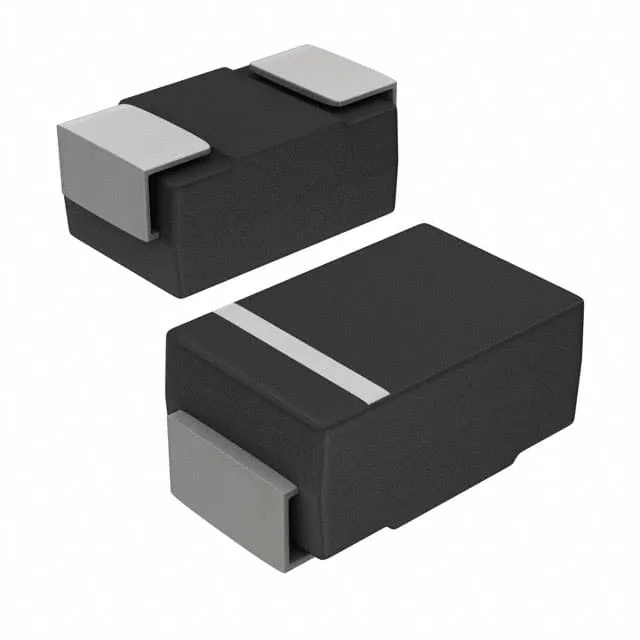
Clamping a 120V rail — what the ratings mean for the board
The SMAJ120A-13-F: The 133V minimum breakdown voltage gives the designer a guard band above the 120V reverse standoff — the rail runs at 120V nominal, and the diode stays out of conduction until a transient pushes past 133V. Rated for 400W peak pulse power, this part handles the surge energy typical of automotive load-dump and inductive kickback events on a 120V bus. The 10/1000µs waveform is the standard telecom and industrial surge test; the 2A peak current at that pulse width is the actual stress the junction absorbs without secondary breakdown.
Active production — no end-of-life scramble
The DO-214AC (SMA) package is a standard JEDEC outline shared across the SMAJ family and many competing TVS series, so the PCB footprint is a commodity. No board spin needed if you switch between Diodes Inc, Littelfuse, or Vishay parts in the same package.
Automotive temperature range — under-hood and industrial ambient
The -55°C to +150°C junction temperature range covers the full automotive under-hood band (Grade 1 equivalent) and industrial enclosures where ambient hits 85°C or higher. The 150°C TJ(max) means the diode can sit on a hot PCB near a regulator or power stage and still clamp a transient without derating the peak pulse power. The Automotive application designation in the spec suggests the part is qualified to AEC-Q101, the automotive discrete semiconductor stress test standard. That means it has passed the production part approval process (PPAP) requirements for temperature cycling, ESD, and humidity bias — not just the commercial-grade JEDEC flow.