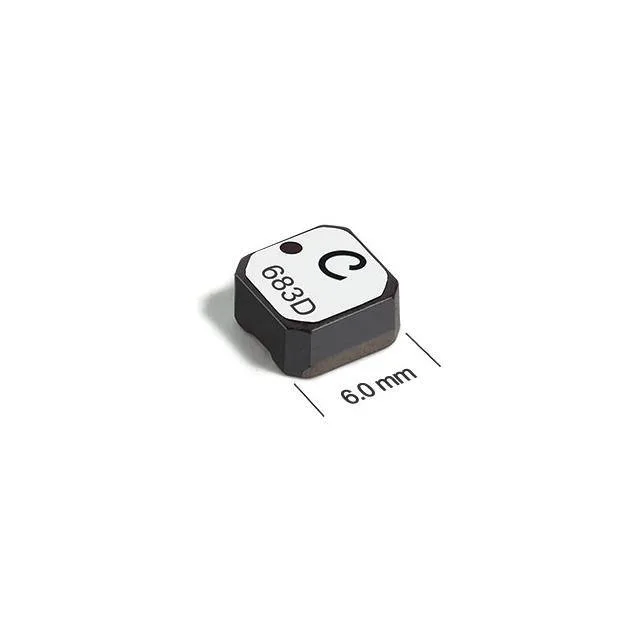
Active production — still a BOM-able line item
The LPS6235-153MRC: This is a current-production part you can specify into a new design without worrying about a last-time-buy window closing mid-build.
15 µH, 1.22 A — the three numbers that decide fit
The headline ratings are 15 µH inductance at ±20% tolerance, 1.22 A continuous current rating, and a saturation current (Isat) of 1.9 A. The DC resistance is 125 mOhm max — that DCR times the square of the load current is the copper loss that heats the part. For a 1 A rail, expect I²R loss around 125 mW; at 1.22 A it hits 186 mW. The saturation current of 1.9 A means the inductance holds within ±20% of the 15 µH value up to that peak — beyond it the core saturates and the inductance collapses, so the Isat figure is the real hard ceiling for transient currents.
AEC-Q200 — what the automotive grade means
Rated AEC-Q200, the passive-component stress-qualification standard. That means the part passed thermal shock, vibration, mechanical shock, solder heat, moisture resistance, and life testing at the temperature extremes. For a DC-DC converter in an engine-control module or a sensor power supply seeing -40°C cold starts and 125°C under-hood soak, this grade gives the reliability margin a commercial-grade inductor does not carry.
Shielded drum core on ferrite — EMI and saturation
The construction is a shielded drum core with a ferrite core material. The magnetic shield contains the flux within the component body, which reduces radiated EMI into adjacent traces or other inductors on a dense board. The ferrite core gives a higher saturation flux density than powdered-iron alternatives, which is why the Isat (1.9 A) sits well above the continuous rating (1.22 A) — the core does not saturate until nearly 60% over the rated current.
Footprint and board fit — 2424 (6060 metric)
The package is 2424 (6060 metric) — 6.20 mm × 6.20 mm body, 3.50 mm seated height. Surface-mount, shielded, with a ferrite core. The strip packaging means it ships in a tube or tray rather than tape-and-reel; confirm the feeder compatibility if your pick-and-place line expects reel-fed parts. The self-resonant frequency is 25 MHz, so the inductor behaves inductively up to that point — above 25 MHz the parasitic capacitance between windings dominates and the impedance starts to fall.