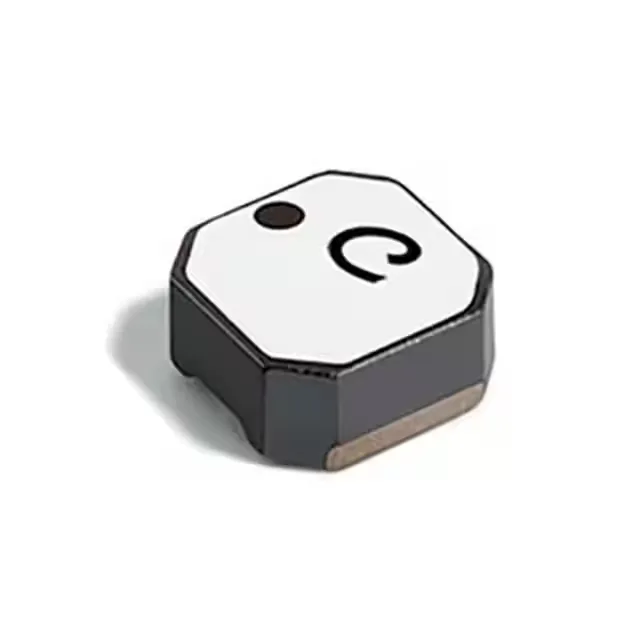
What the 1.9 A rated current and 4.8 A saturation tell you
The LPS4018-561MRC: The 1.9 A continuous rating is the DC current that raises the temperature by a defined delta (typically 40 °C) above ambient — this is the thermal limit for steady-state operation in your power rail. The 4.8 A saturation current (Isat) is where the inductance drops by a specified percentage (usually 10-30%), meaning the core is saturating and the inductor no longer stores energy effectively. For a buck converter or a filter choke, you size the inductor so the peak inductor current stays below Isat with margin; the RMS current should be at or below the 1.9 A thermal rating for reliable operation. The 33 mOhm max DCR is the winding resistance. At 1.9 A, the I²R loss is 0.12 W, which contributes to the self-heating. In a dense power supply, that 120 mW may matter for thermal budget; in a lower-current application the DCR loss is negligible.
AEC-Q200 and the automotive qualification
AEC-Q200 qualification means this inductor has passed the stress tests defined by the Automotive Electronics Council for passive components: thermal shock, humidity bias, mechanical shock, vibration, solderability, and terminal strength. AEC-Q200 qualification combined with this temperature range makes the LPS4018-561MRC suitable for engine control units, transmission controllers, and other under-hood power supplies.
Shielded drum core — why it matters for EMI
The shielded construction uses a ferrite core with a magnetic shield that contains the flux within the component. This reduces radiated EMI compared to an unshielded drum core, which is important when the inductor sits near sensitive analog circuits, RF sections, or other power rails on the same board. It also reduces the chance of crosstalk between adjacent inductors in a multi-phase supply. The self-resonant frequency (SRF) of 250 MHz is the frequency at which the inductor's parasitic capacitance resonates with its inductance, turning it into a high-impedance parallel tank. Above this frequency the component behaves capacitively, not inductively. For switching frequencies below about 25 MHz (1/10th of SRF), the inductor behaves as a pure inductor; the 250 MHz SRF gives plenty of headroom for typical 1-2 MHz DC-DC converters.
The 3.90 mm x 3.90 mm x 1.80 mm (0.154" x 0.154" x 0.071") nonstandard surface-mount package fits the LPS4018 family footprint. The strip packaging means the parts come in a cut-tape or tube format rather than a full reel, which is typical for engineering samples or small-batch production. For volume orders, verify the reel quantity with your distributor.