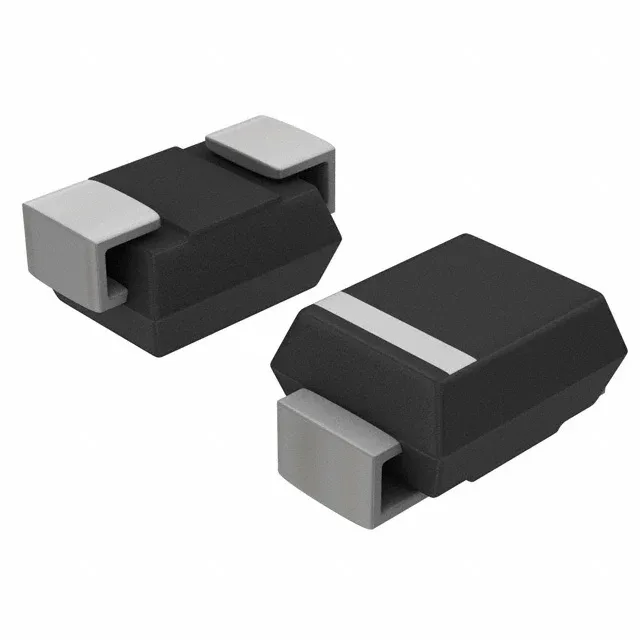
What the 5.0SMDJ8.0CA-QH protects
The 5.0SMDJ8.0CA-QH is a bidirectional Zener-based transient voltage suppressor — the "CA" suffix confirms it clamps both polarities on a single polarity-independent part. Its job is to absorb a voltage spike on the line and clamp it before the downstream circuit sees destructive overstress. Rated 5000W peak pulse at 10/1000 µs — this is the standard telecom and automotive surge waveform, a fast-rise spike that decays over a millisecond. That 5 kW rating tells you it sits on a rail that sees real surge exposure, not just a noise-filtering role.
Standoff, breakdown, and clamping — what each voltage means
Breakdown begins at 8.89 V minimum — above this the Zener junction avalanche-conducts and the part transitions from off to protective clamping. The clamping voltage ceiling is 13.6 V max at the rated peak pulse current of 367.7 A. That 13.6 V is what the downstream IC or module sees at the peak of the surge — pick your downstream absolute-max rating above this, with margin.
Automotive qualification and thermal margin
The series designation Automotive, AEC-Q101, 5.0SMDJ-Q flags this as automotive-grade — AEC-Q101 is the discrete semiconductor stress test standard covering temperature cycling, humidity, mechanical shock, and solder heat resistance. It is the qualification that separates an automotive-qualified TVS from a commercial-spec part for engine-compartment or chassis-domain deployments. Operating junction temperature runs to 150°C — the -55°C cold end covers cold-start and high-altitude conditions; the 150°C top end gives margin above the under-hood ambient peaks a summer grade reaches. Bourns specifies the recommended land pattern — follow it for the thermal pad solder joint integrity the AEC-Q101 board-level thermal cycling test requires.
Where a 5 kW bidirectional TVS fits
Bidirectional, single-channel — it clamps one signal or power rail in both directions. If you have a differential pair needing symmetrical protection, two of these in anti-parallel or a dedicated bi-directional bridge configuration handles it.
Active lifecycle, sourcing posture
Sourced to order per BOM quantity. Tape & Reel packaging matches standard SMT assembly flow.