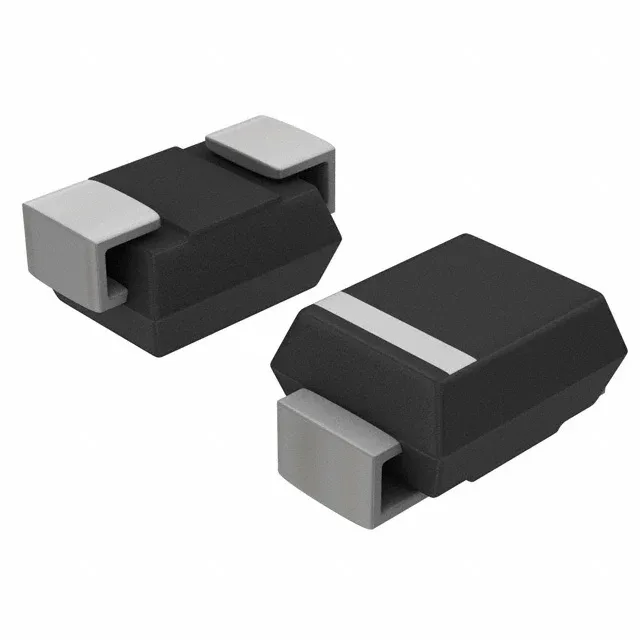
What the 5.0SMDJ30A-Q is built for
The 5.0SMDJ30A-Q is a unidirectional Zener-based TVS diode from Bourns' 5.0SMDJ-Q series, AEC-Q101 qualified for automotive environments. AEC-Q101 is the automotive discrete semiconductor qualification standard — it covers temperature cycling, humidity bias,ESD robustness, and mechanical stress screening. For an ECU input or power rail that sees load-dump transients, this is the minimum gate. The 30V reverse standoff voltage means the TVS stays invisible to the protected rail during normal operation. When a transient exceeds 30V, the device clamps within its rated clamping ceiling.
Clamping ceiling and the transient survivability envelope
The peak pulse rating of 5000W at 10/1000µs defines the transient waveform the diode survives without degradation. The 10µs rise and 1000µs fall matches the ISO 7637-2 automotive load-dump pulse shape, so this part is sized for real vehicle transients, not lab-only surges. Peak pulse current at that waveform is 103A — above this current the clamping voltage climbs and the diode enters irreversible peak surge damage. Verify the downstream clamping voltage budget against the protected IC absolute-maximum rating.
Temperature grade and automotive deployment
Maximum junction temperature is 150°C with an operating range of -55°C to 150°C — the lower bound covers cold-start conditions, the upper bound accommodates engine-compartment proximity without derating at typical automotive board layouts. This is the temperature band that maps to the under-hood ECU environment, not cabin-grade 85°C parts. An engineer specifying for a chassis-domain module needs the headroom the TJ 150°C provides.
Surface-mount termination suits high-volume assembly with reflow. The tape-and-reel and cut-tape options cover both production reel and prototype one-off ordering.
No official successor order code appears in the manufacturer's cross-reference data.