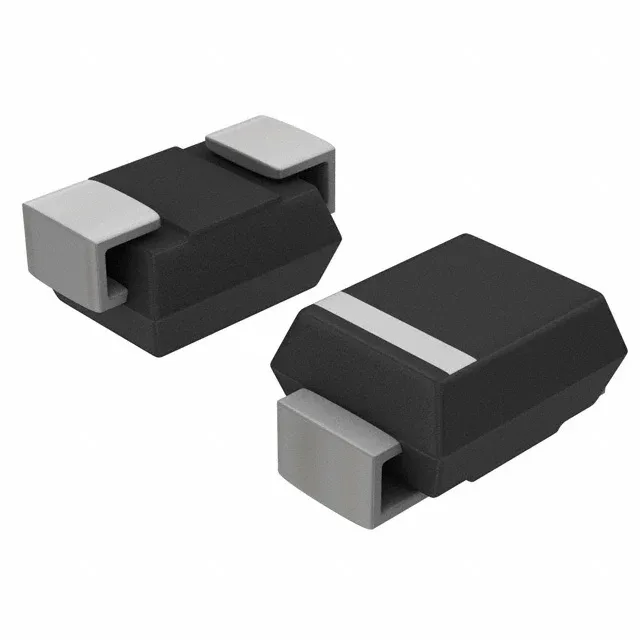
Clamping architecture — what the voltage band means
The 5.0SMDJ22CA-Q: The CA polarity code confirms bidirectional symmetry — the same clamping characteristic applies in either polarity, making this a drop-in for AC rails or lines that experience both positive and negative transients.
At 141 A through the clamping voltage of 35.5 V the part dissipates roughly 5 kW for the duration of the 10/1000 µs waveform — this is the standard automotive surge shape defined in ISO 7637-2 and similar load-dump profiles. The diode's job is not to block the surge but to clamp it and let the upstream supply or protection upstream absorb the energy. Verify the thermal pad land pattern against the Bourns landing pattern drawing; a lifted heel on the cathode tab is the most common field failure mode for surface-mount TVS diodes under repetitive surge stress.
Automotive grade — what the AEC-Q101 qualification signals
AEC-Q101 is the automotive discrete semiconductor stress qualification — it covers temperature cycling, high-temperature reverse bias, power temperature cycling, and mechanical shock/vibration that the part must survive without degradation. For a TVS diode protecting an ECU input or CAN/LIN bus node, this qualification means the clamping characteristic is guaranteed across the automotive temperature band throughout the vehicle design life. In engine-compartment or direct-chassis routing the ambient can reach 125 °C+, leaving 25 °C of junction margin at full surge load.