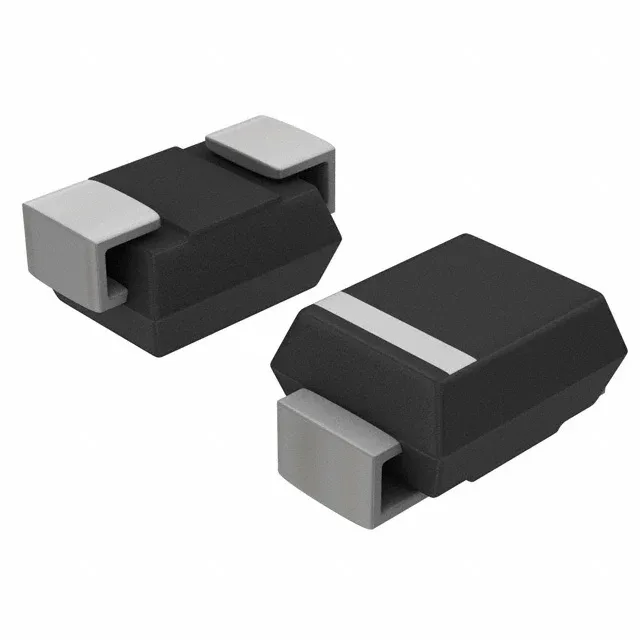
What the voltage ratings mean on a 12V automotive rail
The 5.0SMDJ20A-Q: A 12 V automotive rail sees 13.5-14 V during charging; the 20 V standoff gives the 40% headroom the system-level designer requires for load-dump events without triggering the clamp prematurely. The minimum breakdown of 22.2 V is where conduction begins — until a transient pushes the line above this, the diode draws only leakage current and the protected bus sees nothing. The gap between the 20 V standoff and the 32.4 V clamp is the protection window — the tighter this window, the better the downstream IC is spared.
Why the AEC-Q101 grade and temperature range matter
The AEC-Q101 qualification is not a marketing label — it is a defined stress-test sequence (temperature cycling, humidity, surge, mechanical shock) that gates this part for automotive under-hood and chassis-domain deployment. A non-automotive TVS in the same SMC package may share the electrical rating but fails an automotive safety review on qualification grounds alone. The single unidirectional channel means polarity matters — the cathode connects to the rail being protected, the anode to ground. The surface-mount DO-214AB (SMC) package follows the standard 3-lead footprint; the cathode band marking identifies orientation on the reel.