150 V standoff — what the clamping window means for your rail
The 5.0SMDJ150A-QH: That 243 V ceiling is the figure that protects the downstream semiconductor — the downstream device sees a defined voltage spike, not an unbounded surge. As a unidirectional device, this part handles single-polarity transients only — positive-going spikes on a positive rail. Bidirectional variants of the same series exist for AC-coupled nodes or rails where both polarities can appear.
5 kW peak pulse — automotive surge endurance
5000 W peak pulse dissipation at the 10/1000 µs standard automotive surge waveform means this part survives the ISO 7637-2 pulse 2a and similar load-dump events without going into thermal runaway.
AEC-Q101 — the qualification that opens the automotive BOM
AEC-Q101 stress testing covers temperature cycling, high-temperature reverse bias, humidity bias, and surge life — the failure modes that kill a TVS in engine-compartment or outdoor telecom deployments. Specifying a non-AEC-Q101 TVS on an automotive BOM risks a PPAP rejection; the QH suffix on this part signals that Bourns has run the qualification matrix and the data package is available. The listed applications — Automotive and Telecom — reflect the two environments where a 150 V standoff rail most commonly appears: ECU input protection downstream of the battery rail, and telecom distribution frames where the supply bus sits at 48 V nominal with tolerance headroom that can reach 150 V in fault conditions.
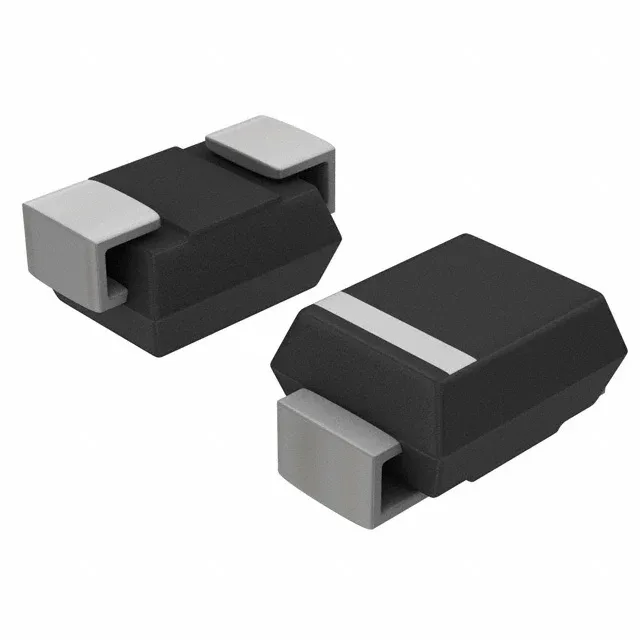
SMC package — surface-mount footprint for high-current clamping
The DO-214AB (SMC) package mounts flush to the PCB and requires a generous copper pad under the cathode tab for thermal relief — the datasheet specifies the recommended land pattern for a reason. At 20.6 A peak pulse the clamping thermal event is brief but intense; the board-level heat spreading from that tab determines whether the part survives repeated surges without dry-film delamination. Tape-and-reel packaging is standard for SMC parts run on automated pick-and-place lines — confirm the reel diameter and quantity per reel match your assembly feeder configuration before the first build.