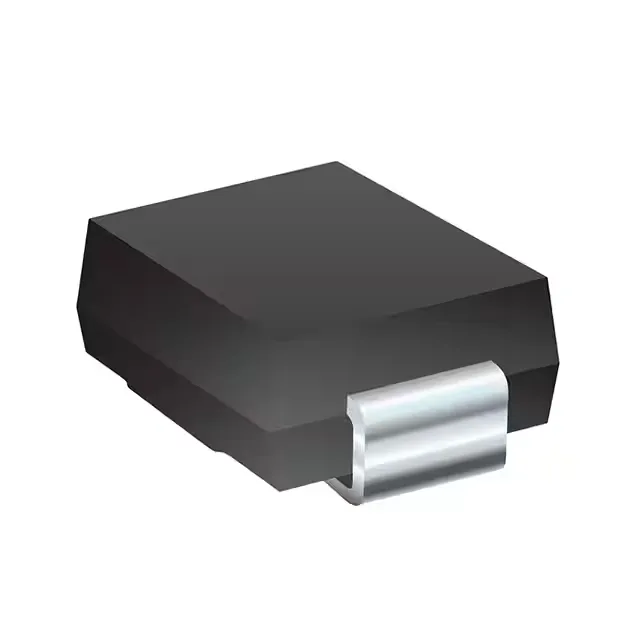
5 kW peak pulse, 13 V standoff — telecom protection spec
The 5.0SMDJ13CA-H: The 13 V reverse standoff (typ) sets the continuous working voltage the protected rail sits below during normal operation. Telecom line cards and RF front-ends running on 12 V or lower rails are the primary deployment for this voltage class.
Stand-off, breakdown, and clamp — what the three voltages mean
The minimum breakdown of 14.4 V is where the Zener action begins; at that point the device transitions from high-impedance leakage to active clamping. The 21.5 V clamping maximum is the voltage across the TVS terminals at the rated peak pulse current of 233 A — the downstream IC must survive 21.5 V on that timescale or sit behind a secondary clamp.
Operating temperature and bidirectional topology
Junction temperature rating runs to 150°C, which gives margin for hot-swap telecom shelves and outdoor cabinet deployments where ambient can spike. The single bidirectional channel means it clamps both polarities — appropriate for data lines and unbalanced power rails where the transient can swing either direction, versus a unidirectional part that only handles one polarity.
Reel packaging and SMT assembly
Supplied on tape-and-reel or cut tape; the anode cathode marking on the top surface identifies polarity — the bidirectional designation (CA suffix) means the part is symmetrical and pin 1 / pin 2 are electrically equivalent, so orientation on a symmetric layout is not polarity-critical.