Clamping chain — standoff through breakdown to clamp
The 1.5SMC68CA-Q: The reverse standoff of 58.1 V typ is the working rail — the device sits idle below this voltage, drawing only leakage current. At 64.6 V min the avalanche breakdown kicks in, which is the protection threshold; anything above it the TVS clamps hard. This rating, combined with the 16.5 A peak pulse current, tells you the clamping impedance is roughly 2 Ω — the series resistance inside the TVS that determines how much voltage headroom remains between the standoff and the clamp during a real event.
AEC-Q101 qualification for automotive deployments
The AEC-Q101 suffix marks this part as qualified to the automotive electronics stress standard — it has passed temperature cycling, humidity bias, ESDA (human-body model), and surge-life testing at the component level. That makes it the correct choice for any ECU input, CAN/LIN bus, or power rail protection on the vehicle side of the harness, not just general industrial use.
SMC package and board integration
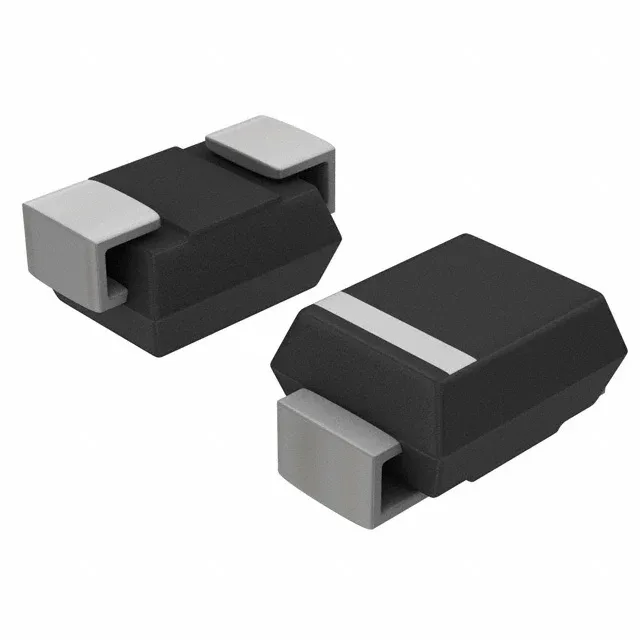
The DO-214AB (SMC) is a two-terminal gull-wing package — the cathode band marks the polarity end. Thermal layout matters: the cathode pad carries the surge current during a clamp event, so the land pattern under the cathode should use the maximum copper area the board stack-up allows. Surface-mount pick-and-place compatible in Tape & Reel packaging — the standard orientation for high-volume assembly. Verify the land pattern matches the Bourns recommended footprint drawing; the SMC shares the same body size as the SMA and SMB but has a higher current rating, so the pad geometry differs from the lower-power siblings.