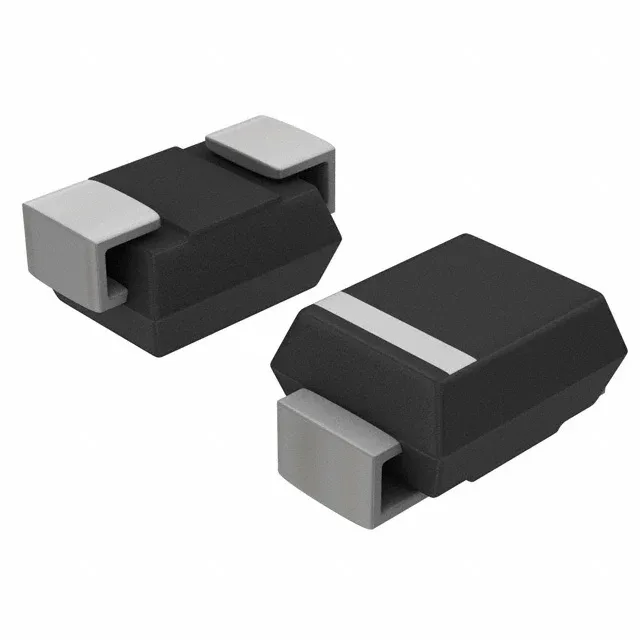
What a 1500W TVS diode does on your board
The 1.5SMC68A-Q is a unidirectional Zener-based TVS (transient voltage suppressor) in the DO-214AB SMC package, qualified AEC-Q101 for automotive circuits — it clamps voltage spikes on a data or signal line before they reach sensitive downstream components. That 92 V clamping ceiling is the number your downstream IC input absolute-max rating must stay above — pick a standoff that sits comfortably below your normal operating rail and a clamping ceiling that clears your protected load. The junction temperature rating of -55 to 150 °C covers engine-bay ambient swings; derate linearly above 125 °C if the board runs hot.
AEC-Q101 — what that qualification means for automotive builds
AEC-Q101 is the discrete semiconductor stress qualification standard: it puts this diode through temperature cycling, humidity bias, operating life, and surge stress testing to a level that automotive OEMs require for safety-critical and under-hood circuits. If your BOM is targeting IATF 16949 or an OEM PPAP submission, this part clears the semiconductor screening gate — a generic commercial TVS in the same SMC package does not carry that pedigree. The listed applications — Automotive and Telecom — reflect the two environments where this grade of screening is typically specified.
SMC reel packaging and surface-mount rework realities
The DO-214AB (SMC) is a mid-size surface-mount package — wide enough (about 6.1 mm body) that hot-air rework is straightforward compared to QFN or BGA. The cathode band on the body marking is your pin-1 orientation reference. Tape-and-reel packaging means the part comes on a wound reel for automated pick-and-place; if you're hand-placing a prototype build, unspool and hand-solder the leads directly — the wide solder pads self-align under reflow. Pre-bake is not typically required for this moisture-sensitivity level, but follow the reflow profile in the Bourns datasheet for the peak and dwell to avoid cracking the die inside the body under thermal excursion.