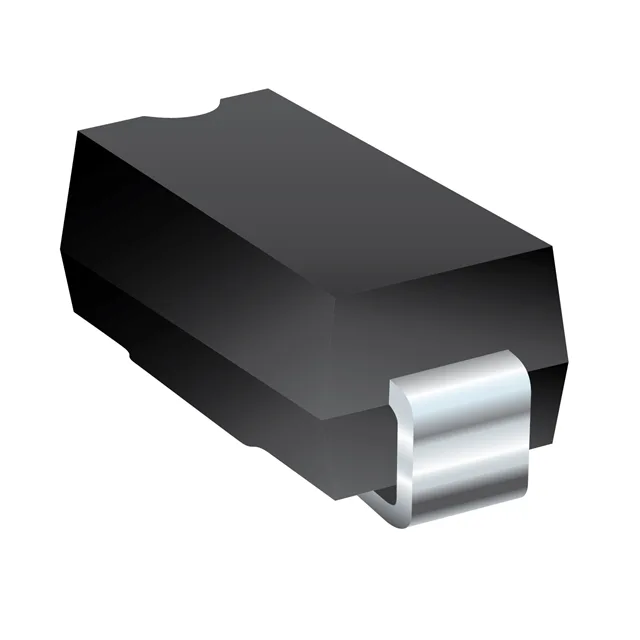
What the 1500 W peak pulse rating means for your protection design
The 1.5SMBJ43CA-H: That 1500 W figure means the device can clamp a 21.7 A transient (the peak pulse current at that waveform) to 69.4 V maximum, absorbing the surge energy without failing — a common benchmark for protecting 24 VDC or 28 VDC rails in automotive and industrial systems. The reverse standoff voltage is 43 V, meaning the diode draws negligible leakage below that level. Breakdown occurs at 47.8 V minimum, and clamping is held to 69.4 V at the rated current — a tight enough clamp-to-standoff ratio (1.6:1) to protect downstream silicon rated for 75 V or higher.
Automotive qualification and deployment context
This part carries AEC-Q101 qualification, the automotive discrete semiconductor stress-test standard. The operating junction temperature range spans -55°C to 150°C, covering the full automotive temperature envelope including cold-crank and hot-soak conditions.
Bidirectional configuration and general-purpose use
No power line protection feature is listed, so it is intended for signal and low-power supply rail clamping rather than mains or high-current DC bus protection. The part is catalogued for general-purpose applications, which covers the majority of transient suppression needs outside specialized sectors like aerospace or medical — industrial control, telecom, and automotive auxiliary circuits all fall within scope.