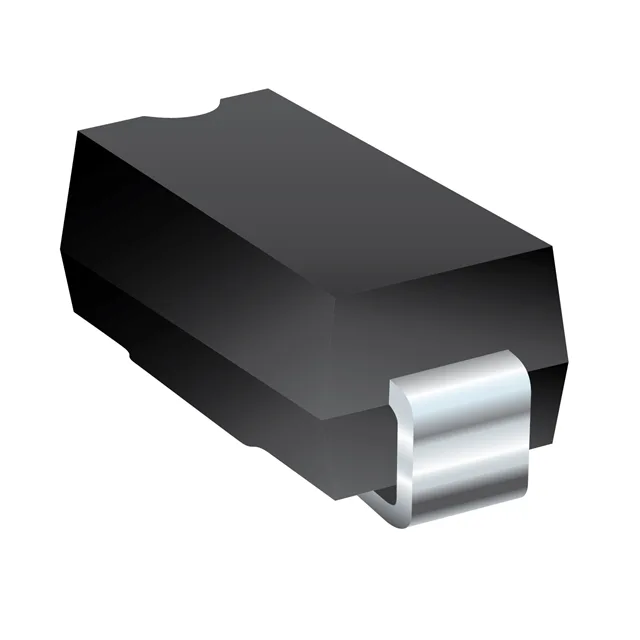
Active automotive TVS — 1500 W peak pulse, AEC-Q101 qualified
The 1.5SMBJ16CA-H: The AEC-Q101 qualification (cite:) places it in the automotive-grade bin — the part is screened for the reliability stress and temperature cycling requirements of tier-one ECU programs.
Voltage stack and surge capacity — what the ratings mean for the BOM
The three-voltage stack — 16 V standoff, 17.8 V minimum breakdown, 26 V maximum clamping — defines the protection window. A 12 V or 15 V rail sees no leakage at nominal voltage; the diode only conducts when the transient exceeds the breakdown knee. The 26 V clamp ceiling limits the voltage the downstream IC sees during a surge, which keeps the stress within the abs-max rating of most 24 V-tolerant automotive loads. Peak pulse current is 57.7 A at the 10/1000 µs waveform (cite:). This is the surge-handling capacity under the standard telecom/industrial pulse shape — a 57.7 A transient lasting 1 ms is absorbed without the diode failing short. The 1500 W peak pulse power (cite:) is the product of the clamp voltage and the pulse current; it is the headline derating figure for the DO-214AA package. The 150°C upper limit covers the under-hood ambient plus self-heating during the pulse — the AEC-Q101 grade (cite:) validates the die-attach and wire-bond reliability across this range. The single bidirectional channel (cite:) protects both positive and negative transients on the same line, which saves a diode count on CAN, LIN, or sensor signal pairs.
DO-214AA SMB footprint and packaging options
The supplier device package is SMB (DO-214AA) (cite:), which means the PCB footprint matches the JEDEC standard for this outline. Surface-mount mounting (cite:) suits automated pick-and-place assembly. Available in Tape & Reel (TR) or Cut Tape (CT) (cite:). The reel option is the production format for volume assembly; cut tape serves prototyping and low-volume builds. The base product number is 1.5SMBJ (cite:), which is the family prefix for the 1500 W SMB series from Bourns.