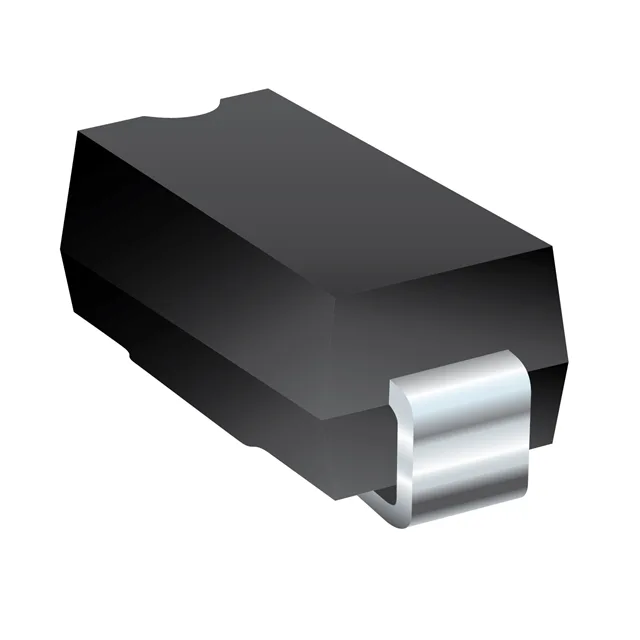
Automotive TVS — what the ratings mean for the rail
The 1.5SMBJ14A-H: At the 14 V reverse standoff voltage it sits idle, drawing negligible leakage; when a transient pushes the rail above 15.6 V (the minimum breakdown voltage), it clamps at 23.2 V max while shunting 64.7 A peak pulse current. That clamping voltage is the number your downstream IC's abs-max rating must survive — a 24 V-rated ECU supply has margin; a 16 V-rated sensor rail does not. The -55 to 150 °C junction temperature range covers the full under-hood ambient envelope with derating headroom — at 125 °C case temperature the 1500 W rating derates to roughly 60 %, so the actual transient energy the device can absorb drops in a hot engine bay. Design the clamp current budget at the worst-case operating temperature, not at 25 °C.
Package fit and footprint
DO-214AA (SMB) — same footprint as the rest of the 1.5SMBJ series. The cathode band aligns with the package marking; the anode is the tab. Solder pad geometry per the Bourns recommended land pattern: a 2.0 mm wide pad on the cathode side with a thermal via under the tab pulls heat into the inner-layer copper pour. Reflow profile follows standard JEDEC J-STD-020 for a moisture sensitivity level (MSL) 1 device — no bake required before reflow if the shelf life in the sealed bag is unbroken.