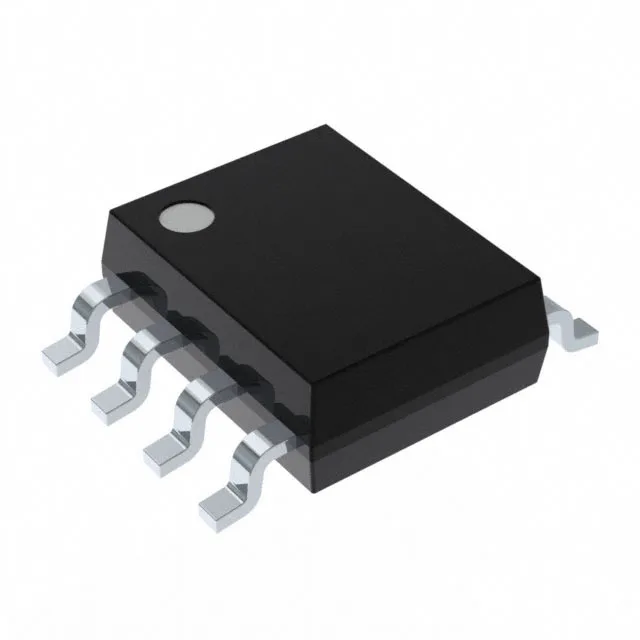
Supply rail and timing — the two decisions that define fit
The MAX992ESA+: 210 ns maximum propagation delay sets the upper frequency limit for the signal chain — a zero-crossing detector or PWM threshold monitor must budget this delay into the loop timing. Two independent comparator elements in the 8-SOIC package share the supply pins but maintain separate inputs and outputs, so a single device handles two threshold channels.
Output flexibility and noise rejection
The output stage supports CMOS, open-drain, rail-to-rail, and TTL logic levels — the open-drain option lets multiple comparators wire-AND on a shared pull-up bus, common in fault-monitoring arrays. 80 dB typical CMRR and PSRR mean the comparator holds its threshold against common-mode voltage shifts and supply ripple, which matters in motor-drive or switching-power-supply environments where the ground plane carries switching noise. ±2.5 mV hysteresis is built in to suppress output chatter on slowly changing analog signals — without it, a sensor input hovering near the threshold would toggle the output at the comparator's bandwidth limit.
Industrial temperature grade and quiescent budget
96 µA maximum quiescent current per device keeps the comparator's own draw low enough for battery-powered thresholding — a smoke-detector or remote-sensor node that leaves the comparator powered continuously sees under 100 µA from this block.
Input characteristics for high-impedance sources
1 pA maximum input bias current at 5.5 V means the comparator loads the source by less than a picoamp — negligible for a 10 MΩ sensor or a photodiode transimpedance front-end. 5 mV maximum input offset voltage at 5.5 V defines the threshold accuracy floor: a window comparator with a 100 mV window must budget ±5 mV per comparator into the trip tolerance, leaving 90 mV of usable window.