Current sense for tight spots
The MAX9928FAUA+T is a single-channel current sense amplifier from Analog Devices, built for measuring current on the high side or low side of a supply rail. It fits into systems where you need to know what a load is drawing without dropping much voltage across the sense resistor. Its 150 kHz bandwidth means it can track current changes faster than many general-purpose op-amps — good for catching short-circuit events or monitoring PWM-driven loads where the switching frequency stays under that corner. The 20 µA supply current keeps it happy in battery-powered gear; the quiescent draw won't eat into the measurement budget. The -40°C to 125°C range puts it into industrial enclosures and under-hood automotive modules where the ambient gets hot.
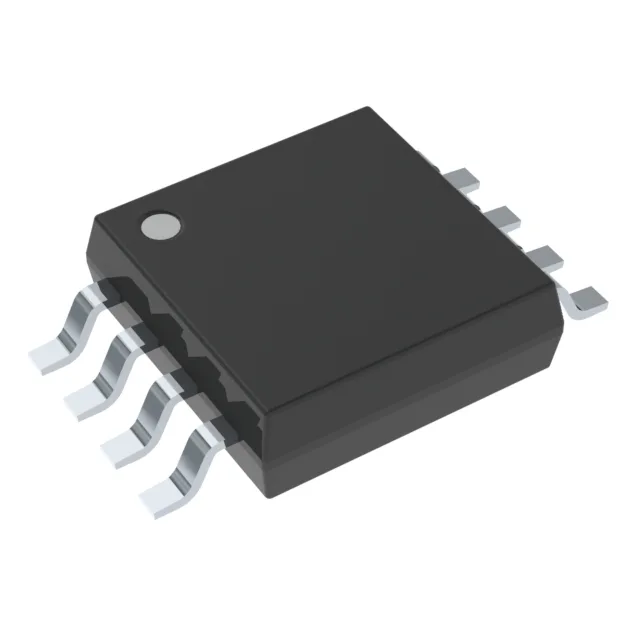
The 1.6 µA input bias current flows into the sense resistor and creates a voltage offset that adds to the measurement error. With a 10 mΩ shunt, that bias generates just 16 µV of extra drop — negligible for most applications, but worth checking if you are sensing sub-milliamp currents through a larger resistor. Input offset voltage is 600 µV maximum. That sets the floor on how small a current you can resolve: at a gain of 50 V/V, 600 µV at the input corresponds to 30 mV at the output, which may be significant if your ADC's least-significant bit is smaller than that. The 8-TSSOP/MSOP package (also called 8-uMAX/uSOP) is a common footprint for small-signal analog parts. The MSOP body is roughly 3 mm wide, so it fits into tight layouts near the sense resistor.