Active production — what this means for the BOM line
The MAX986EXK+T: ROHS3 compliant per the manufacturer's listing, so it meets the current EU restriction levels without a waiver.
Key parametric fit — speed, power, and input sensitivity
450ns maximum propagation delay sets the comparator's response ceiling — for a typical 24 VDC sensor input with a 1 kHz edge rate, this delay is well within the margin, but a fast fault-detection loop switching at 100 kHz will see the output lag by nearly half a cycle. 24µA maximum quiescent current means the comparator's own draw is negligible in a battery-powered sensor node that sleeps between readings — the supply budget stays with the microcontroller and radio. 1pA maximum input bias current at 5.5V is low enough that a 10 MΩ source impedance produces only 10 µV of offset error — the input bias term is not the dominant error in a high-impedance front-end like a pH probe or photodiode amplifier. 5mV maximum input offset voltage at 5.5V sets the threshold accuracy floor — for a 100 mV reference trip point, the worst-case offset contributes 5% error; a precision reference and resistor divider are needed if the threshold must hold within 1%.
Supply rail and output flexibility
Output type supports CMOS, open-drain, rail-to-rail, and TTL logic levels — the open-drain option lets multiple comparators share a pull-up for a wired-OR interrupt line, and the rail-to-rail swing drives an ADC input directly without a level shifter. 80dB typical CMRR and PSRR mean common-mode noise on the input pair and supply ripple are each attenuated by 10,000:1 — a 100 mV power-supply glitch appears as only 10 µV of input-referred error.
Package and board-fit — SC-70-5 rework reality
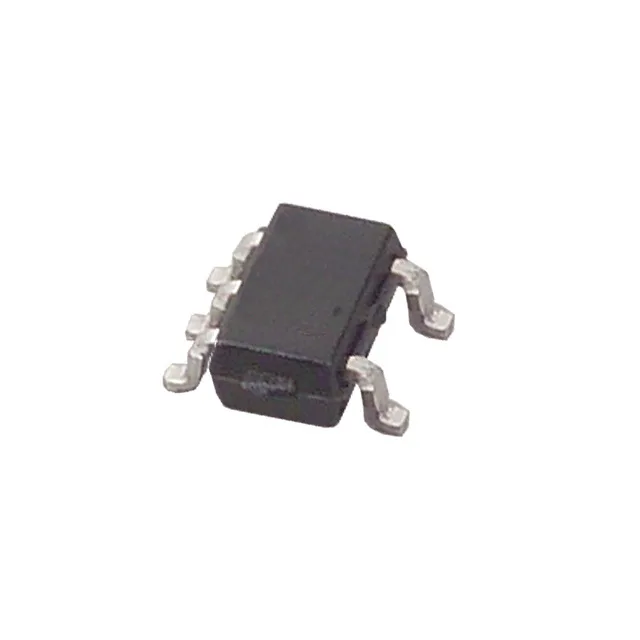
Pin 1 is clearly marked by a bevel on the package corner; no orientation ambiguity. CT is the prototyping slice. Both are ROHS3 compliant.
A general-purpose comparator (Type: General Purpose) — no internal reference, no hysteresis adjustment pin. The ±3mV hysteresis is built in to prevent output chatter near the threshold. Single-element device — one comparator per package. For multi-channel window detection or multi-level thresholding, you need one package per channel. Suitable for outdoor telecom cabinets, factory-floor sensor interfaces, and engine-bay electronics that see under-hood temperatures.