Class G topology and output power — what drives the BOM decision
The MAX9788ETI+ is a Class G mono amplifier delivering 2.4W into an 8Ω load from a single 2.7V to 5.5V supply. Class G architecture switches between two supply rails to improve efficiency over a conventional Class AB stage — the output stage runs from a lower rail at low signal levels and transitions to a higher rail only when the signal crest demands it, cutting quiescent dissipation in a battery-powered speaker or headset driver. Rated output is 2.4W x 1 channel at 8Ω — this is the continuous power into a single speaker before clipping. For a portable Bluetooth speaker or a hands-free car-kit speaker, that power level drives moderate volume in a small enclosure; the actual SPL depends on the speaker sensitivity and enclosure tuning.
The 2.7V to 5.5V supply range covers a single-cell Li-ion battery (nominal 3.6V, full 4.2V, end-of-discharge ~3.0V) and the common 3.3V or 5.0V regulated rails. Differential inputs reject common-mode noise picked up on long input traces from the codec or baseband processor — useful when the amplifier sits on a separate PCB from the audio source. The shutdown pin (active-low) pulls the quiescent current to near-zero for battery conservation during idle periods.
Package and thermal — what the 28-TQFN exposed pad demands from the layout
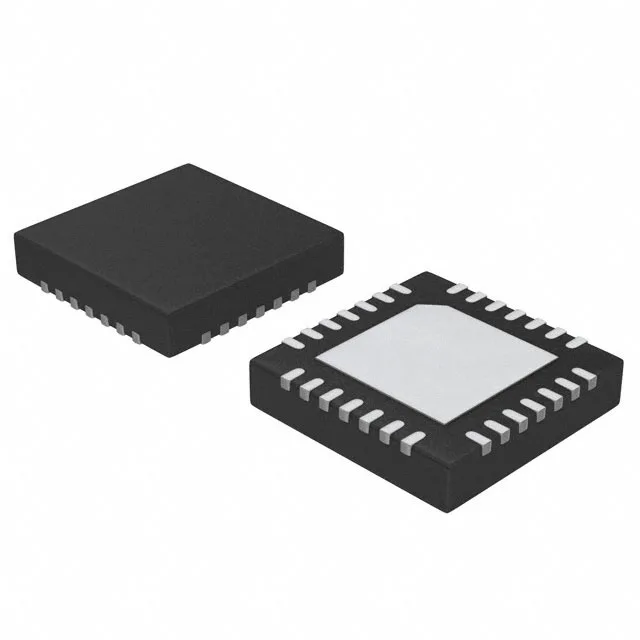
The 28-TQFN (5x5 mm) exposed-pad package requires a thermal land on the PCB to sink heat from the Class G output stage. Without adequate thermal vias, the junction temperature rises above the 85°C ambient limit when delivering 2.4W into 8Ω continuously. The 0.5 mm pitch QFN demands a solder-paste stencil aperture that matches the land pattern — a 4-mil stencil with 1:1 aperture-to-land ratio is typical. The depop feature (pop-and-click suppression) is a bias-circuit timing adjustment that eliminates startup transients; it does not require external components beyond the standard input DC-blocking capacitor.