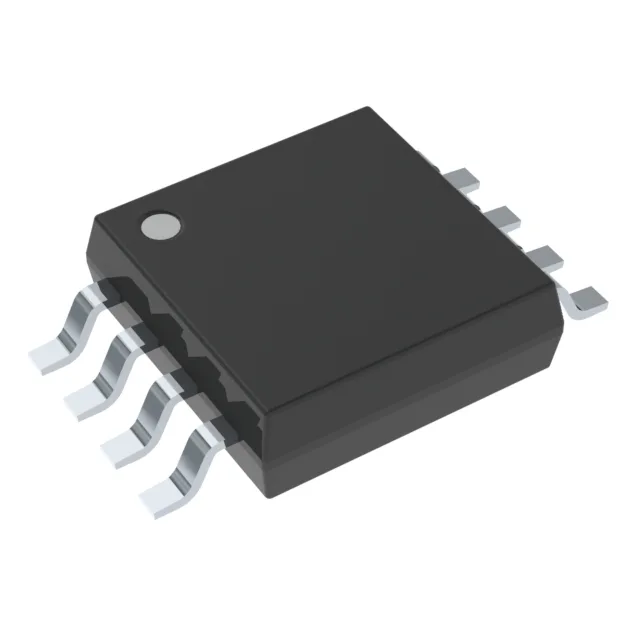
The MAX976EUA+: ROHS3 compliant per the manufacturer's declaration, which covers the full substance restriction scope of the EU RoHS directive including the four phthalates. No exemption claims or REACH SVHC flags are attached to this order code.
28 ns propagation delay — signal-chain timing margin
Maximum propagation delay of 28 ns sets the comparator's response ceiling from overdrive to output transition. In a high-speed ADC driver or zero-crossing detector, this delay plus the output rise time into the load capacitance determines the total loop latency — budget it at the system level, not just the comparator alone. This matters when the comparator drives a logic input directly without a level shifter.
95 dB CMRR, 100 dB PSRR — common-mode and supply rejection
95 dB common-mode rejection ratio means the offset voltage shifts less than 18 µV per volt of common-mode change — negligible in a 2 mV max offset device. Quiescent current maxes at 650 µA for both comparators combined — roughly 325 µA per channel. In a battery-powered threshold monitor that runs continuously, this is the dominant standing current; the 28 ns propagation delay allows the comparator to wake from a low-power state only when the input crosses the reference, keeping average draw lower.
8-uMAX/uSOP footprint — board-fit considerations
Housed in the 8-lead uMAX/uSOP package (3.00 mm body width, 0.65 mm pin pitch), the MAX976EUA+ shares the same footprint as the industry-standard 8-MSOP. The 0.118-inch (3.00 mm) width fits tight channel-density layouts where four comparators in a 14-pin TSSOP would exceed the board edge. Surface-mount assembly with a standard MSOP-8 land pattern; no exposed thermal pad to route.