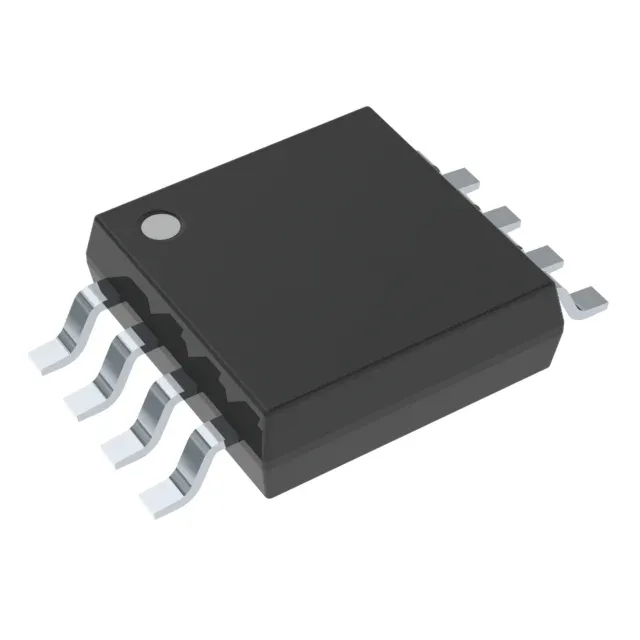
Dual window comparator — threshold monitoring with one IC
The MAX968EUA+T: Its window-comparator architecture uses two internal comparators with a common reference to detect whether an input signal falls inside or outside a defined voltage window, rather than comparing against a single threshold.
20 µs propagation delay — low-frequency threshold detection
Maximum propagation delay is 20 µs, which sets the usable bandwidth for threshold monitoring. This is adequate for power-supply undervoltage/overvoltage detection, battery monitoring, and sensor window comparators where the signal changes at sub-50 kHz rates. Built-in ±1 mV hysteresis prevents output chatter when the input signal sits near the threshold boundary — a common failure mode in single-threshold comparators driving digital inputs. Quiescent current is 16 µA maximum, making this comparator suitable for battery-powered equipment where every microamp matters. The input bias current is 0.05 µA maximum at 5.5 V, so high-impedance sensor outputs (10 kΩ to 1 MΩ source resistance) do not load the signal source significantly.
Industrial temperature range and supply rejection
Typical CMRR is 56.48 dB and PSRR is 80 dB. The 80 dB supply rejection means a 100 mV ripple on the 5 V rail translates to roughly 10 µV of offset shift at the comparator input — negligible for a 15 mV maximum input offset voltage.
8-uMAX/uSOP package — board integration
The supplier device package is listed as 8-uMAX/uSOP, which is Analog Devices' proprietary thin MSOP variant.
ROHS3 compliant (no exemptions), meeting the current EU RoHS directive for lead-free and halogen-free assembly.