1.1 µA supply current — what it means for a battery-powered sense node
The MAX9634WERS+T is a single-channel current-sense amplifier from Analog Devices' nanoPower series, drawing just 1.1 µA from the supply rail. That quiescent current is the part's defining spec for battery-operated designs: a sensor node that sleeps most of the time and wakes to measure load current every few seconds will see the amplifier's own draw as a negligible fraction of the system budget. Gain-bandwidth product is 125 kHz, so the measurement bandwidth covers DC through low-frequency load transients — suitable for average-current monitoring in portable devices, battery fuel gauging, or power-rail supervision where the signal of interest changes slowly. Input offset voltage is 100 µV typical, setting the DC error floor. For a 10 mΩ sense resistor carrying 1 A, the 10 mV sense signal sees a 1% offset contribution from the amplifier alone — the designer budgets this against the target measurement accuracy.
4-UCSP (1x1 mm) — board-fit and assembly
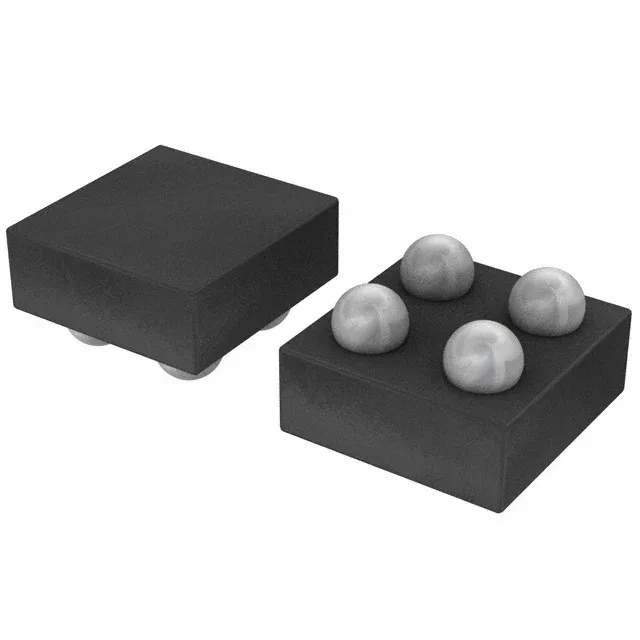
The part comes in a 4-bump wafer-level chip-scale package, 1x1 mm body (4-UCSP). No leads, no exposed paddle — the bumps are the only interface to the board. The solder-joint reliability depends on the PCB pad geometry matching the bump pitch and the reflow profile following the JEDEC moisture sensitivity level for the package. Surface-mount only — no through-hole equivalent exists. Operating temperature range is -40°C to 85°C, covering industrial indoor and outdoor gear but not extended automotive or under-hood environments.