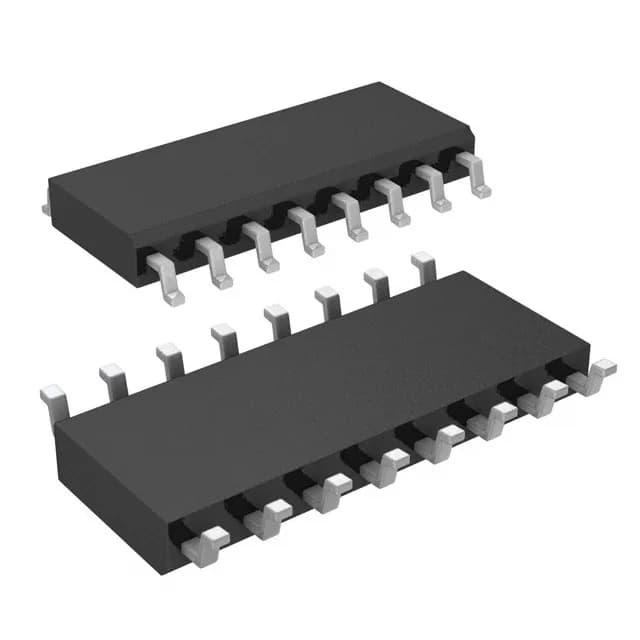
Analog Devices MAX934CSE+ — DC-DC Power Modules

MAX934CSE+ Quad Comparator with Voltage Reference, 12µs

MPNMAX934CSE+
End of Life

Maxim Integrated MAX934CSE+, quad comparator with integrated voltage reference, CMOS/TTL output, 12µs propagation delay, 8.5µA quiescent current, 2.5V to 11V single supply, 16-SOIC surface-mount package, 0°C to 70°C operating temperature.

$6.95Ref. price · indicative, final on quote
Packaging16-SOIC (0.154", 3.90mm Width)
StockContact for availability
MOQ1 pcs
  • 100% new & originalTraceable channels only — no refurbs, no pulls, no remarked parts.
  • Date & lot codes on quoteStated per line before you commit; label photos on request.
  • MSL-compliant ESD packingMoisture-sealed bags with indicator cards; reels photo-verified.
  • PayPal buyer protectionPay by T/T, PayPal or Payoneer — card payments covered end to end.

Specifications

MAX934CSE+ Technical Specifications
ParameterValue
Typewith Voltage Reference
Output typeCMOS, TTL
Mounting typeSurface Mount
Voltage - input offset10mV @ 5V
Voltage - supply, single (Dual (±))2.5V ~ 11V, ±1.25V ~ 5.5V
Current - output0.015mA @ 5V
Current - quiescent8.5µA
Operating temperature0°C ~ 70°C
PackageTube
Case16-SOIC (0.154\", 3.90mm Width)
CMRR, PSRR80dB CMRR, 80dB PSRR
Number of elements4
Propagation delay12µs

Product details

Quad comparator with a built-in voltage reference — one chip replaces four

The Maxim Integrated MAX934CSE+ packs four independent comparators and a precision 1.182V voltage reference into a single 16-SOIC package. That reference is the differentiator versus a plain quad comparator like the LM339 — it saves you an external reference IC, two bypass caps, and the PCB real estate they'd occupy. Typical applications include battery-powered threshold detectors, window comparators, and 0°C to 70°C commercial-grade supervisory circuits where board space and quiescent current are the constraints.

12 µs propagation delay — slow by modern standards, deliberate by design

The 12 µs max propagation delay is not a speed demon — you wouldn't use this for switching-regulator feedback or high-speed zero-crossing detection. But that delay is the direct result of the 8.5 µA max quiescent current across all four comparators plus the reference. For line-frequency (50/60 Hz) monitoring, over-temperature sensing with a thermistor, or battery undervoltage lockout, 12 µs is plenty fast, and the sub-10 µA total draw is what makes it viable for always-on monitoring in portable gear.

2.5V to 11V supply — fits 3.3V and 5V rails without a regulator

The supply range spans 2.5V to 11V single supply, or ±1.25V to ±5.5V dual supply. That means it runs directly off a 3.3V or 5V logic rail without an extra LDO. The CMOS/TTL output stage swings rail-to-rail, so it drives logic inputs cleanly at either voltage. Input offset voltage is specified at 10 mV max at 5V — adequate for threshold detection where the trip point has several hundred millivolts of hysteresis.

80 dB CMRR and PSRR — noise rejection for dirty environments

Typical common-mode and power-supply rejection ratios are both 80 dB. That matters when the comparator shares a board with a switching regulator or motor driver: the 80 dB PSRR means supply ripple at 100 mV peak-to-peak translates to roughly 10 µV of input-referred error — negligible for a 10 mV offset comparator. The 80 dB CMRR keeps the threshold accurate even when the input signal rides on a noisy ground plane.

Active production — no end-of-life concern for new builds

The MAX934CSE+ carries an Active product status and is ROHS3 compliant.

Frequently asked questions

Is MAX934CSE+ equivalent to LM339?

Not a direct pin-for-pin swap. Both are quad comparators in a 16-pin SOIC package, but the MAX934CSE+ includes an on-chip 1.182V voltage reference and draws only 8.5 µA quiescent current, versus the LM339's roughly 2 mA. The pinout differs — the MAX934 uses the reference output on pin 1, while the LM339 has an open-collector output stage versus the MAX934's CMOS/TTL push-pull outputs. They serve different design targets: the MAX934 is for low-power, reference-integrated threshold detection; the LM339 is a general-purpose open-collector comparator.

What is the MAX934CSE+ propagation delay?

The maximum propagation delay is 12 µs. This is specified for the comparator output transitioning from low to high or high to low. The 12 µs figure is relatively slow compared to high-speed comparators, but it is a direct trade-off for the ultra-low 8.5 µA quiescent current. It is well suited for 50/60 Hz line monitoring, temperature sensing, and battery monitoring applications.