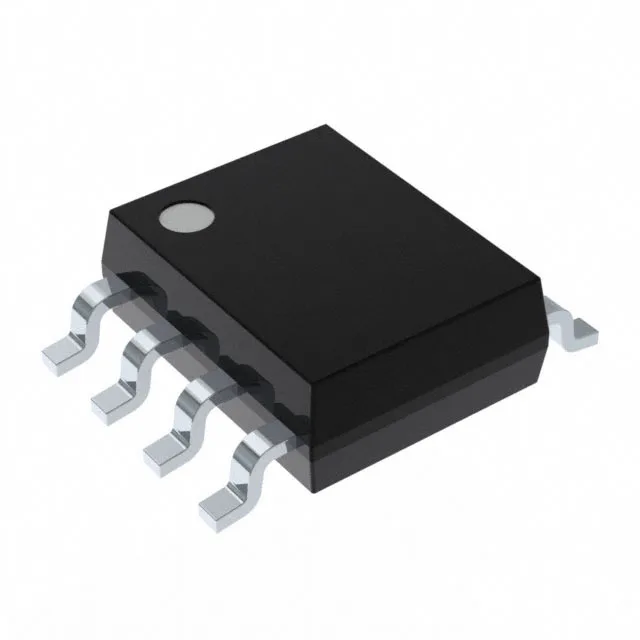
8-SOIC comparator with on-chip reference
The MAX921ESA+ is a single comparator with an integrated voltage reference, housed in an 8-SOIC package (0.154" width, 3.90 mm body). The built-in reference saves an external component and one PCB trace — useful when board area is tight and the reference voltage doesn't need to be shared across multiple channels. Supply range spans 2.5 V to 11 V single, or ±1.25 V to ±5.5 V dual. The 5 µA max quiescent current makes it a candidate for battery-powered threshold detectors where the comparator sits powered continuously. Output swings CMOS or TTL levels and can source up to 50 mA typical — enough to drive a small relay coil or an optocoupler LED directly without a buffer transistor.
50 mV hysteresis and 12 µs propagation delay
Built-in 50 mV hysteresis prevents output chatter when the input signal crosses the threshold slowly. For a thermistor bridge or a slow-moving analog sensor, this eliminates the need for external positive feedback resistors. Maximum propagation delay is 12 µs. That sets the upper limit on how fast the comparator can toggle — adequate for DC threshold detection and low-frequency window comparators, but not for high-speed zero-crossing or PWM edge detection above roughly 40 kHz. Input offset voltage is 10 mV max at 5 V supply. The integrated reference's accuracy dominates the threshold error budget, so the offset matters most when the external signal is compared against a voltage near the reference value.
Active production, ROHS3, industrial temp range
Common-mode and power-supply rejection are both 80 dB typical. In a noisy 24 V industrial backplane stepped down to 5 V, the 80 dB PSRR attenuates rail ripple by a factor of 10,000 — the comparator's threshold stays stable within a few hundred microvolts.