1.2 µA quiescent — the battery-life decision
The MAX919EUK+T: In a battery-powered sensor node that sleeps 99 % of the time, the comparator's own draw sits below the self-discharge rate of a CR2032 coin cell — the threshold trip circuit does not steal the system's standby budget. Propagation delay is 940 µs max — this is a power-optimised rather than high-speed part. For a slow-moving signal like a thermistor bridge or a photodiode integrator that changes over milliseconds, the 940 µs delay adds negligible phase error. For a fast overcurrent latch or a zero-crossing detector switching at kHz rates, this part is too slow. The built-in 4 mV hysteresis cleans up the switching threshold on a noisy sensor line without external positive feedback resistors. For a battery monitor comparing a divided voltage against a 1.2 V reference, the 4 mV band keeps the output from chattering near the trip point as the load current fluctuates.
Output stage and supply flexibility
The push-pull rail-to-rail output swings within millivolts of both supply rails, so it drives a CMOS logic input directly without a pull-up resistor. The 50 mA typical output current can also sink or source enough to switch a small MOSFET gate or an LED indicator. The 66 dB CMRR and 80 dB PSRR keep the threshold stable when the battery voltage sags or the ground plane carries switching noise.
Package and provenance check
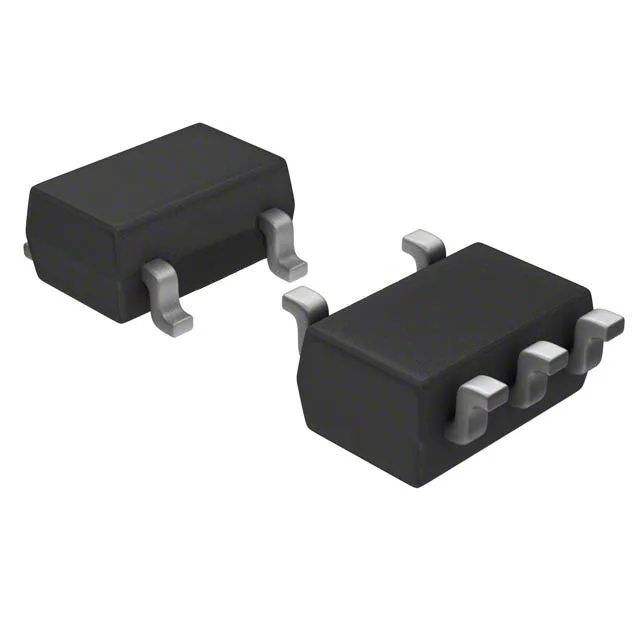
Housed in a 5-lead SOT-23 (SC-74A), the land pattern is a standard 0.95 mm pitch. The input bias current is a maximum 0.001 µA at 5 V — negligible for a 100 kΩ source impedance, so the voltage divider network does not need a buffer. Maximum input offset voltage is 5 mV at 5 V. For a precision threshold within 1 % of a 1.2 V reference, the 5 mV offset adds a 0.4 % error — acceptable for most window comparators, but a tighter-grade part would be needed for a 0.1 % accurate overvoltage trip.
Lifecycle and sourcing posture
ROHS3 compliant. Sourced through independent distribution channels. The part is quoted to order — no stock-holding claim, no lead-time number, but the supply chain is active and the date-code consistency can be verified on request.