Analog Devices MAX9108ESD+ — DC-DC Power Modules

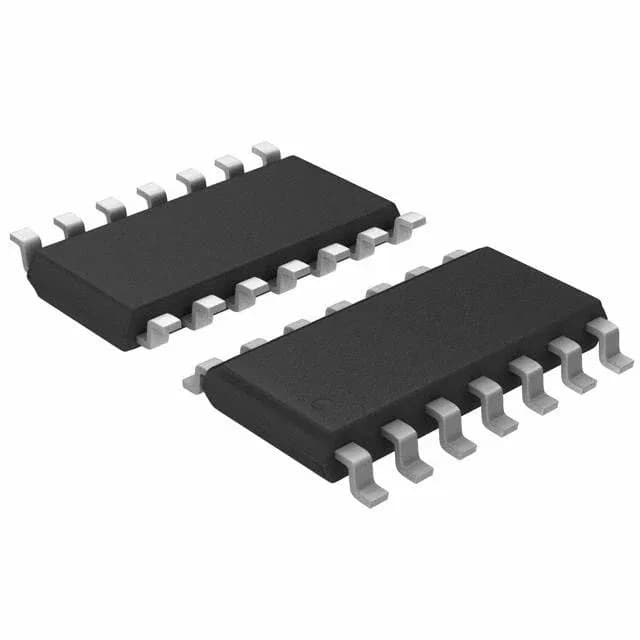
MAX9108ESD+ Quad Comparator, 25ns, 14-SOIC

MPNMAX9108ESD+
End of Life

Maxim Integrated MAX9108ESD+, General Purpose quad comparator, 25ns propagation delay, 4.5V to 5.5V supply, TTL output, 14-SOIC package, -40°C to 85°C.

$5.33Ref. price · indicative, final on quote
Packaging14-SOIC (0.154", 3.90mm Width)
StockContact for availability
MOQ1 pcs
  • 100% new & originalTraceable channels only — no refurbs, no pulls, no remarked parts.
  • Date & lot codes on quoteStated per line before you commit; label photos on request.
  • MSL-compliant ESD packingMoisture-sealed bags with indicator cards; reels photo-verified.
  • PayPal buyer protectionPay by T/T, PayPal or Payoneer — card payments covered end to end.

Specifications

MAX9108ESD+ Technical Specifications
ParameterValue
TypeGeneral Purpose
Output typeTTL
Mounting typeSurface Mount
Voltage - input offset1.6mV @ 5V
Voltage - supply, single (Dual (±))4.5V ~ 5.5V
Current - quiescent700µA
Current - input bias0.125µA @ 5V
Operating temperature-40°C ~ 85°C
PackageTube
Hysteresis2mV
Case14-SOIC (0.154\", 3.90mm Width)
CMRR, PSRR86.02dB CMRR, 86.02dB PSRR
Number of elements4
Propagation delay25ns

Product details

Quad comparator with 25 ns propagation delay — signal-chain fit

The Maxim Integrated MAX9108ESD+ is a quad general-purpose comparator packing four independent comparators into a single 14-SOIC package. Its 25 ns maximum propagation delay makes it a candidate for high-speed threshold detection, zero-crossing circuits, and fast overcurrent or overvoltage fault sensing where the decision needs to land within one or two clock cycles of a moderate-speed microcontroller. The supply range is 4.5 V to 5.5 V single supply. TTL-compatible outputs simplify interfacing to 5 V logic families without level translation. Industrial temperature grade (-40°C to 85°C) suits outdoor telecom cabinets, factory automation panels, and under-hood automotive auxiliary circuits where the ambient can swing hard.

25 ns — what the propagation delay buys you

At 25 ns max, this comparator can resolve a 40 MHz input transition. That is fast enough for switching power supply feedback loops, high-speed data line receivers, and pulse-width measurement on encoder outputs. The trade-off is quiescent current: 700 µA max across all four channels, which is modest for the speed class but not a micropower part. Input offset voltage is trimmed to 1.6 mV max at 5 V, and input bias current stays under 0.125 µA — both tight enough for precision threshold setting without external trimming in most industrial signal chains. CMRR and PSRR both sit at 86.02 dB typical, meaning the comparator rejects common-mode noise and supply ripple well, so the decision threshold stays stable even on a noisy 5 V rail.

14-SOIC package — rework and layout notes

The 14-SOIC (0.154" body width, 3.90 mm) is a standard footprint, easy to route on two-layer boards.

Lifecycle and sourcing — active, no LTB pressure

ROHS3 compliant. That means it is safe to qualify into a new production BOM or to replenish a sustaining line without worrying about a last-time-buy window closing.

Frequently asked questions

What is the propagation delay of MAX9108ESD+?

The maximum propagation delay is 25 ns, which supports signal frequencies up to roughly 40 MHz.

Is MAX9108ESD+ equivalent to LM339?

The LM339 is a quad comparator with open-collector outputs and a wider supply range (2 V to 36 V), while the MAX9108ESD+ has TTL push-pull outputs and a 4.5 V to 5.5 V supply. They are not pin-compatible or direct equivalents — the MAX9108ESD+ is faster (25 ns vs ~1.3 µs) but requires a 5 V rail.

What is the difference between MAX9108ESD+ and MAX9109?

The MAX9109 is a single comparator in a 5-pin SOT-23 package, while the MAX9108ESD+ is a quad comparator in a 14-SOIC. The single version saves board space for one channel; the quad packs four channels in one package for multi-threshold designs.