1.1 µA quiescent current — the battery-life decision
The MAX9060EUK+T: For a threshold monitor that stays awake continuously — battery fuel gauge, power-good supervisor, wake-up detector — this current sits below the self-discharge rate of a CR2032 coin cell, so the comparator does not dominate the sleep budget. Propagation delay is 25 µs max. That is fast enough to catch a supply brownout or a sensor edge in a 10 kHz control loop, but not for a switching power supply cycle-by-cycle current limit — the 25 µs window includes the comparator's internal settling plus the output slew into the load capacitance.
Open-drain output and supply flexibility
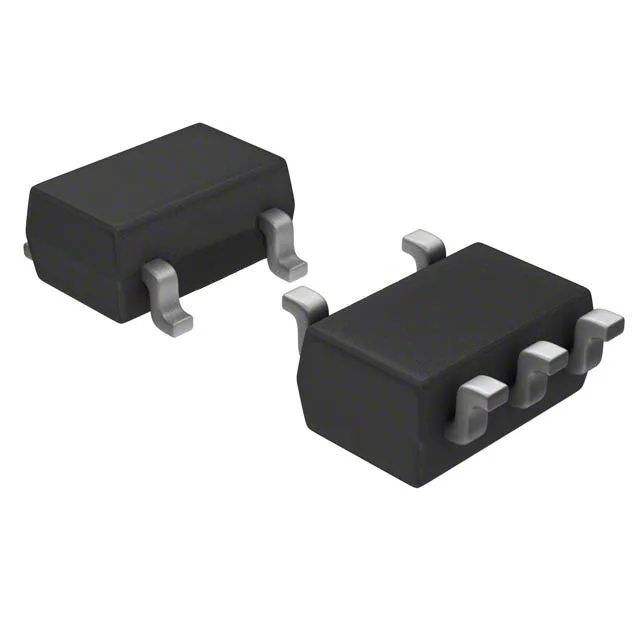
The open-drain output lets the comparator drive a pull-up to a different voltage than the supply rail — a 1.8 V microcontroller input can be driven from a comparator running on a 3.3 V supply, or multiple open-drain outputs can be wire-ORed on a single interrupt line. The output sinks current when the non-inverting input crosses the threshold; the pull-up resistor sets the logic-high level. Input offset voltage is 6 mV max at 1.8 V. For a 100 mV threshold, that is 6 % uncertainty — acceptable for a power-good flag or a window comparator with hysteresis, but not for a precision zero-crossing detector. The ±12 mV built-in hysteresis cleans up noise on slowly moving signals so the output does not chatter near the trip point. Input bias current is 0.01 µA max at 1.8 V. A 10 MΩ source resistor drops only 0.1 mV from bias current — negligible for most threshold dividers. The single-element comparator fits into a 5-pin SOT-23 footprint (SC-74A case code), which is the same land pattern as many general-purpose op-amps and references, so the PCB layout reuses an existing cell.
The comparator's electrical specs are guaranteed across this range, not just at 25°C. Analog Devices lists the MAX9060EUK+T as Active product status.