What this comparator with voltage reference does on the board
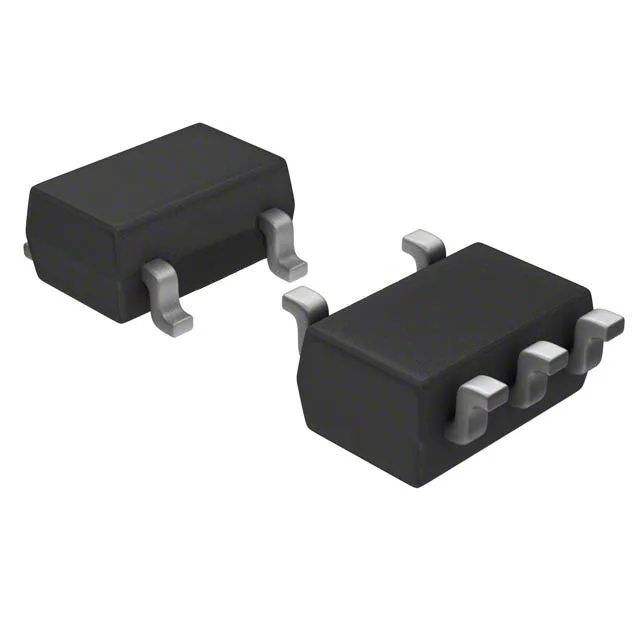
The MAX9050AEUK+T is a single comparator that integrates a precision voltage reference on-chip — one less external component to route and decouple on a tight SOT-23-5 footprint.
Propagation delay, hysteresis, and why they matter for your threshold detect
450 ns max propagation delay sets the bandwidth ceiling — this comparator can cleanly resolve pulse edges at roughly 1 MHz input rate, fast enough for overcurrent trip or zero-crossing detect in a motor drive, but not for a high-speed data slicer. Built-in ±3 mV hysteresis eliminates output chatter when the input signal sits near the reference threshold — no external positive-feedback resistor needed, which saves a part and a PCB trace. The output swings rail-to-rail in CMOS push-pull or TTL mode, so it drives a logic gate input directly without a pull-up resistor.
Low-power operation and input bias for sensor front-ends
Quiescent current maxes at 72 µA — low enough for a battery-powered threshold monitor that stays awake continuously, and the 1 pA input bias current at 5 V means a high-impedance sensor (like a photodiode or pH probe) doesn't see a significant offset from the comparator's own input stage. The 80 dB CMRR and PSRR keep the threshold stable against common-mode shifts and supply ripple — a 1 mV change on the input or rail translates to roughly 0.1 µV of offset shift, negligible in a 5 mV offset-error budget.
Package, temperature grade, and lifecycle for BOM planning
Housed in a 5-pin SOT-23 (SC-74A), surface-mount — the same footprint as countless other comparators and op-amps, so a layout swap to a pin-compatible alternative is straightforward if the BOM needs a second source.