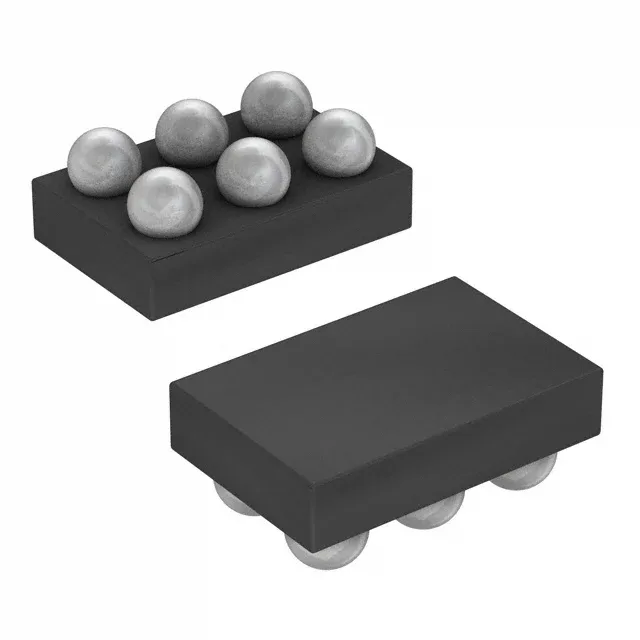
The MAX9027EBT+T: It is ROHS3 compliant, so it meets the latest EU restriction-of-hazardous-substances directive without requiring an exemption. This is a standard catalog part from the Beyond-the-Rails™ series, not a custom or limited-run device — supply continuity is typical for the line.
Ultra-low power for battery-operated threshold detection
The comparator draws a maximum quiescent current of 1.25 µA, which makes it suitable for always-on sense circuits in battery-powered instruments — the quiescent drain is below the self-discharge rate of a typical CR2032 coin cell. Input bias current is a maximum 0.001 µA at 5 V — this is 1 pA typical, so the comparator does not load high-impedance sensor outputs (e.g., pH probes, photodiode transimpedance stages) enough to shift the threshold.
4 mV hysteresis and 40 µs propagation delay — what they mean for the loop
The 4 mV internal hysteresis ensures clean switching when the input signal crosses the reference voltage slowly — without it, noise on a slowly ramping thermistor output would cause multiple transitions as the comparator chatters through the threshold. Maximum propagation delay is 40 µs, which sets the bandwidth ceiling at roughly 12.5 kHz for a square-wave input. This is not a high-speed comparator; it is intended for DC threshold alarms, over-temperature detection, or low-frequency window comparators where speed is secondary to power.
6-WLP package — tiny footprint, careful rework required
The part comes in a 6-bump WLP (Wafer-Level Package), designated 6-WLP or 6-WFBGA, WLBGA. The package body is essentially the size of the silicon die itself — roughly 0.9 mm × 1.3 mm for a 6-bump array — so it saves board space but leaves no plastic overhang to absorb rework heat. Mounting is surface-mount only. The WLP has solder bumps on the bottom; the board pad pattern must match the bump pitch and diameter exactly. There is no exposed thermal pad — thermal management relies on the board copper and the bumps themselves. For rework: the die is thin and the bumps are small. Hot-air removal needs a preheat to avoid thermal shock that cracks the silicon. A low-temperature solder profile (peak ~230°C) and a fine-tip stencil for reballing are recommended. The part's tiny size means pin 1 identification is critical — look for the chamfered corner or the dot on the package top.
Industrial temperature range and general-purpose type
It is classified as a General Purpose comparator, meaning it has no special features like built-in reference, latch, or shutdown — it is a basic single comparator in a very small package. Typical CMRR is 50.45 dB and PSRR is 60 dB — these are moderate figures. The comparator's offset voltage (5 mV max at 5 V) and hysteresis dominate the threshold accuracy more than common-mode or supply rejection in most low-frequency applications.