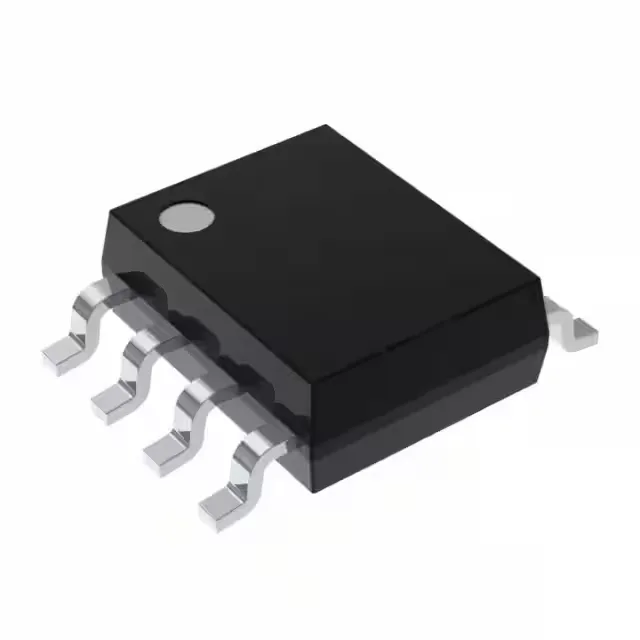
The MAX883CSA+ comes in an 8-SOIC narrow-body package (0.154" wide, 3.90 mm body width) — a standard footprint that reflows on a two-layer board without thermal vias for this current level. The tube packaging means the parts are shipped in anti-static tubes; if your pick-and-place feeder expects tape-and-reel, confirm the tube-to-reel transfer at the CM side.
Dropout and quiescent — the battery-life anchors
Rated for 200 mA continuous output with a maximum dropout voltage of 0.44 V at full load. That means the input rail must stay at least 440 mV above the output voltage across the load range — if your 5 V rail drops to 5.2 V under load, the regulator falls out of regulation. For an always-on sensor node drawing 50 µA from the battery, the regulator's own consumption is a third of the total — the LDO's overhead is significant at light load, so a switching converter may be more efficient below 1 mA.
Output programming and protection
The output is adjustable down to 1.25 V using an external resistor divider, or can be configured as a fixed 5 V output by tying the SET pin to ground — the internal bandgap reference sets the 5 V option. The maximum output voltage is 11 V, limited by the 11.5 V maximum input. Built-in protection includes over-current limiting, thermal shutdown, and reverse-polarity protection on the input. The low-battery detection output (LBO) asserts when the input falls below a programmable threshold — useful for sequencing a microcontroller into safe shutdown before the output drops out.