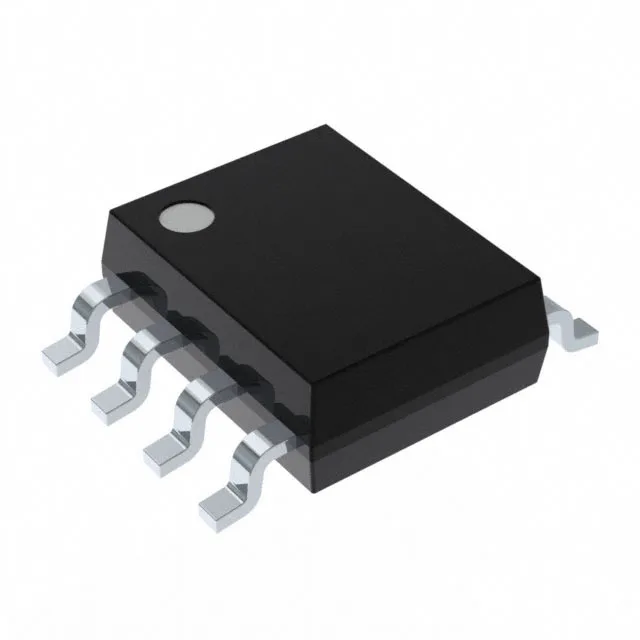
Buck-boost controller in an 8-SOIC footprint
The MAX776ESA+ is a buck-boost switching controller from Analog Devices, designed to regulate an output voltage that can be above, below, or equal to the input — the defining trait of a step-up/step-down topology. It drives an external transistor pair, so the power stage is sized separately from the controller, which keeps the 8-SOIC package cool even when the load pulls several amps. The controller runs from a 3 V to 16.5 V supply rail and switches at a fixed 300 kHz, a frequency that balances inductor size against switching losses for most battery-powered and intermediate-bus designs. The single output is configured as a negative rail — this is the part to reach for when you need a regulated -5 V or -12 V from a positive input, common in op-amp split-supply or LCD bias circuits.
What the 8-SOIC package and 300 kHz switching mean on the bench
The 8-SOIC (150-mil body, 3.90 mm width) is a rework-friendly footprint — hot-air profiles for this package are standard, and the 1.27 mm pin pitch lets you probe every pin without a microscope. The controller itself dissipates little heat (the power FETs are external), so no copper pour heatsink is needed under the IC; a simple 2-layer board with a ground plane under the switching node is enough. At 300 kHz, the external inductor will be in the 10–47 µH range for most designs, and the catch diode should be a Schottky rated for the peak switch current. There is no synchronous rectifier on-chip, so the freewheeling diode's forward drop sets the efficiency floor — expect 80–88 % in a typical -5 V output application, with the diode loss dominating at light loads. The Enable pin lets you shut the controller down to near-zero quiescent current — useful for battery-powered equipment that sleeps between measurement cycles.