Why an 8th-order elliptic filter when a simpler one would do
The MAX7407CSA+ is an 8th-order elliptic low-pass switched-capacitor filter from Analog Devices with a 10 kHz cutoff frequency. The elliptic topology gives a sharp transition band — the stopband attenuation rises quickly after cutoff — which means you can separate a 10 kHz passband from out-of-band noise with a narrower guard band than a Butterworth or Bessel of the same order would allow. That matters when the next stage is an ADC that folds high-frequency noise back into the baseband. No extra regulator, no bipolar supply — just the logic rail and a clock source.
The 10 kHz cutoff sets the anti-aliasing boundary. If your ADC samples at 20 kHz or higher, the filter attenuates signals above 10 kHz so they do not alias into the passband. The 8th-order elliptic response means the stopband attenuation starts within a few hundred Hz of cutoff — much steeper than a 4th-order Butterworth, which would need a higher cutoff to achieve the same alias rejection and would let more out-of-band noise through. Because the filter is switched-capacitor, the cutoff tracks the clock frequency. The datasheet clock-to-cutoff ratio is fixed — a 100 kHz clock gives a 10 kHz cutoff. That lets you tune the filter by changing the clock, but it also means the clock noise couples into the signal path if the clock is not clean.
Active production — no forced redesign
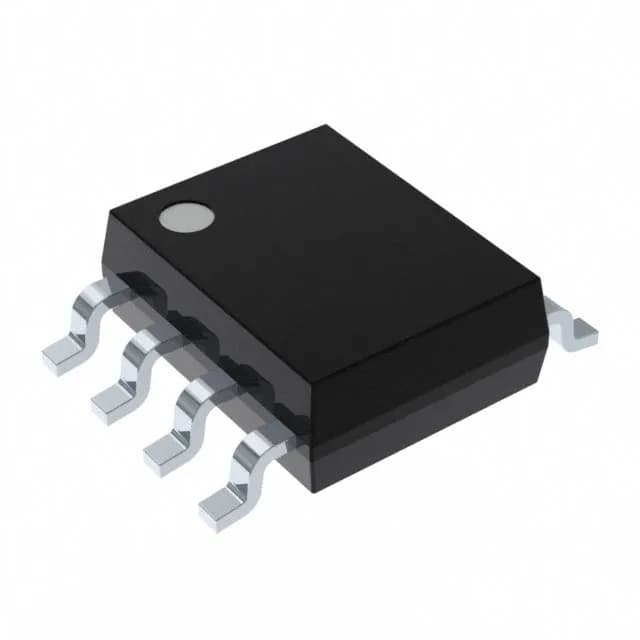
That means standard lead times apply, and the part will be available for new designs without a looming end-of-life notice. The part is supplied in Tube and is ROHS3 compliant. The 8-SOIC package is a common footprint — 1.27 mm pitch, 3.90 mm body width — so it fits existing land patterns without a board spin.