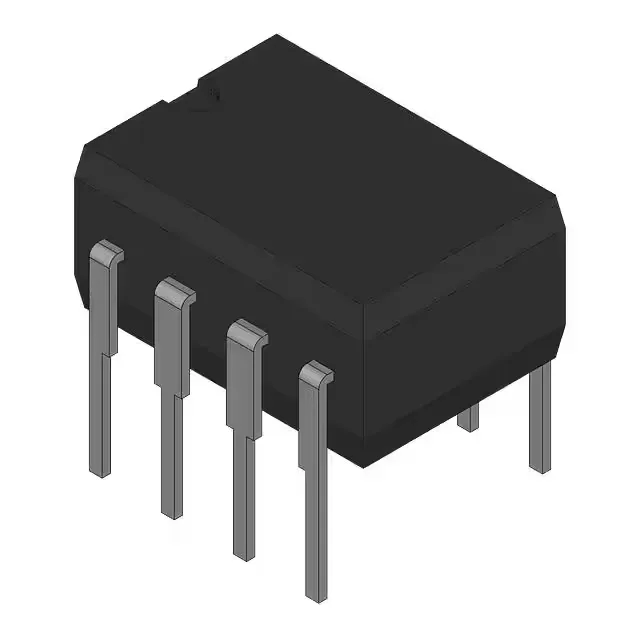
Battery backup supervisor — what this chip does
The Maxim MAX694EPA is a battery backup circuit / MPU supervisor IC that monitors a single supply voltage and asserts a reset signal to the processor when the rail drops below its threshold. It is designed for systems where a backup battery must maintain memory or real-time clock functions during a main power loss — think industrial controllers, PLCs, and embedded instrumentation that need clean power-fail sequencing. The reset output is active-low, push-pull (totem pole), so it drives the processor reset pin directly without an external pull-up resistor. The voltage threshold is 4.65 V.
Package and mounting — through-hole for prototyping and rework
Housed in an 8-pin DIP package (0.300" body width, 7.62 mm pitch), the MAX694EPA is through-hole mount. That makes it a natural choice for breadboard prototyping, socketed evaluation, or replacing a failed supervisor on a legacy PCB where a DIP footprint already exists. The 8-PDIP supplier device package is the same physical part — just the manufacturer's internal code for the plastic DIP variant.
Lifecycle and sourcing — active, but watch the RoHS flag
The part is RoHS non-compliant. For legacy builds or contracts with RoHS exemptions, it remains a valid choice.
Marking and provenance — what to check on incoming inspection
Given the part is through-hole and still active, counterfeit risk is lower than for obsolete or high-volume surface-mount parts, but it is not zero. On a MAX694EPA, the top-side marking should read 'MAX694EPA' in a consistent font — any sanding, re-marking, or laser-etch mismatch across a reel is a red flag. Date-code laser etch on the body should match the manufacturer's plant format for the week claimed. If you are buying from the independent channel, request lot-trace documentation and, for large quantities, consider a decap X-ray to verify the die matches Maxim's known layout for this part.