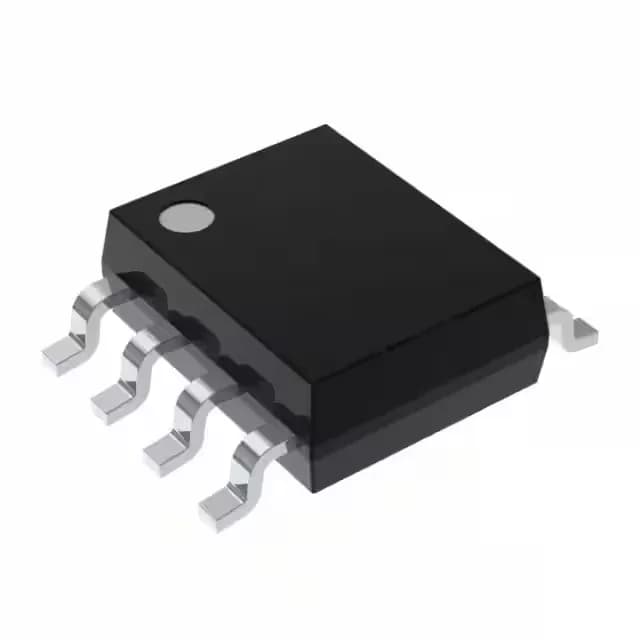
Local/remote digital temperature sensor with I²C/SMBus interface
The Analog Devices MAX6657MSA+ is a digital temperature sensor that measures both its own die temperature (local) and the temperature of an external diode-connected transistor (remote), outputting readings over an I²C/SMBus interface. It carries 10-bit resolution and a supply range of 3V to 5.5V, so it drops into either 3.3V or 5V logic rails without a separate regulator. The -55°C to 125°C operating temperature range qualifies it for military/aerospace, downhole, and engine-bay deployments where the ambient can swing well beyond industrial limits.
What the accuracy spec means for your thermal management loop
Accuracy is listed as ±2°C typical and ±5°C worst-case across the full temperature range. For system monitoring — fan control, over-temperature shutdown, or thermal throttling — ±2°C is tight enough. If you are closing a precision thermal control loop or calibrating against a known reference, the ±5°C limit at the extremes may need a one-point offset correction in firmware. The programmable limit output (one of the listed features) can be set to assert an interrupt or shutdown signal when the temperature crosses a threshold, which works with the ±2°C typical accuracy for a reliable trip point.
Remote sensing — where it earns its keep
The remote-sensing channel measures an external diode (typically a CPU, FPGA, or GPU substrate diode) over a range of 0°C to 125°C. This is the feature that justifies the part over a simpler local-only sensor: you monitor the hot spot on a processor die without placing a thermistor on the heatsink. The local channel simultaneously tracks the board ambient near the sensor itself. The output switch and shutdown mode let you gate a cooling fan or trigger a system halt if either channel exceeds its programmed limit.
Package, mounting, and lifecycle
The MAX6657MSA+ is supplied in an 8-pin SOIC package (0.154" width, 3.90 mm body), surface-mount, and ships in Tube form. Lifecycle status is Active per the manufacturer, with ROHS3 compliance — no near-term EOL concern, no LTB planning needed. For volume production, the Tube quantity sets the per-reel logistics; if your pick-and-place line prefers tape-and-reel, check the alternate ordering code suffix.