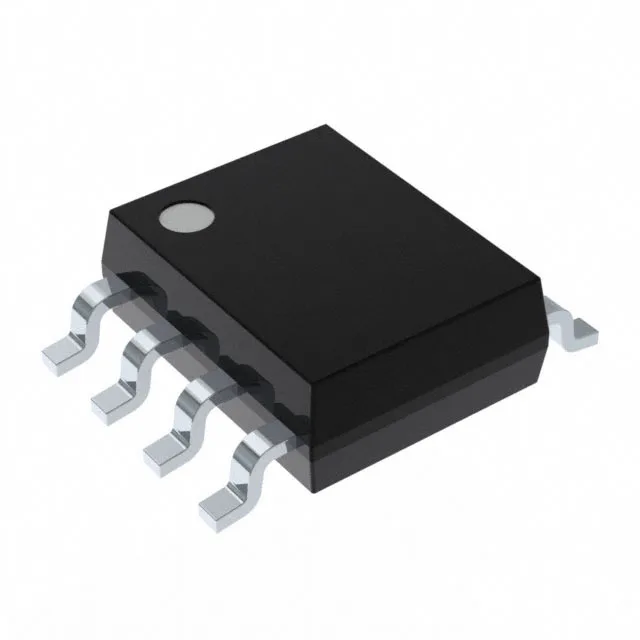
Inverting buck regulator for negative rail generation
The MAX635ACSA+ is an inverting buck (step-down) regulator from Analog Devices that produces a negative output voltage from a positive input rail — a less common topology than the standard positive buck, but essential when a circuit needs a -5 V or adjustable negative bias from a 5 V or 12 V supply. Rated for 500 mA continuous output current, it handles the bias rail for an op-amp front-end, a small LCD contrast supply, or the negative supply in a mixed-signal board where the positive rail is already regulated. The switching frequency is 50 kHz — low enough that the inductor and output capacitor are physically larger than what a modern 500 kHz+ part would need, but the trade-off is lower switching losses and cleaner output ripple for noise-sensitive analog loads.
Input range and output flexibility
The output is adjustable down to -1.31 V minimum, with a fixed -5 V option available by tying the feedback pin appropriately — the datasheet shows the resistor divider values for any intermediate voltage. The single output is configured as a negative rail, meaning the load connects between the output pin and ground, not between output and input — a common gotcha for engineers used to positive buck converters.
Package and thermal considerations for 500 mA
The commercial temperature grade (0°C to 70°C ambient) limits the part to indoor, temperature-controlled environments — not suitable for automotive, industrial enclosures without HVAC, or outdoor telecom cabinets where the internal temperature can exceed 70°C. Without synchronous rectification, the external Schottky diode carries the inductor current during the off-time — its forward voltage and thermal rating must be selected to match the 500 mA output and the switching frequency.
Active production and compliance status
It carries ROHS3 compliance, meaning it meets the current European Union restriction on hazardous substances — no exemptions for lead in solder or cadmium in plating.