Active production — no end-of-life watch needed
The MAX6175AASA+: ROHS3 compliance is confirmed, with no exemption carve-outs that would restrict global shipping or require a waiver for EU-market equipment.
5V precision reference — tolerance, drift, and noise floor
Output is fixed at 5V with an initial tolerance of ±0.06% — that is 3 mV of absolute error at 25°C before temperature and aging effects are added. For a 12-bit ADC with a 5V reference, this tolerance alone contributes roughly 2.5 LSB of gain error, which is correctable in software calibration if the system budget allows. Temperature coefficient is 3 ppm/°C typical. This places the part in the precision band where a trimmed voltage divider or a lower-drift reference would be needed only for 16-bit-plus systems.
Output drive and supply headroom
Rated for 30 mA output current — enough to bias multiple ADC reference inputs, a handful of op-amp dividers, or a small sensor bridge without an external buffer. The series topology means the load current is drawn from the input supply, not from a bandgap core, so the 700 µA quiescent supply current is independent of the load. Input voltage range is 7V to 40V, giving 2V of dropout headroom at the minimum input. This allows the reference to run from a 12V or 24V industrial rail, a 9V battery, or a loosely regulated intermediate bus without a pre-regulator.
8-SOIC footprint and temperature grade
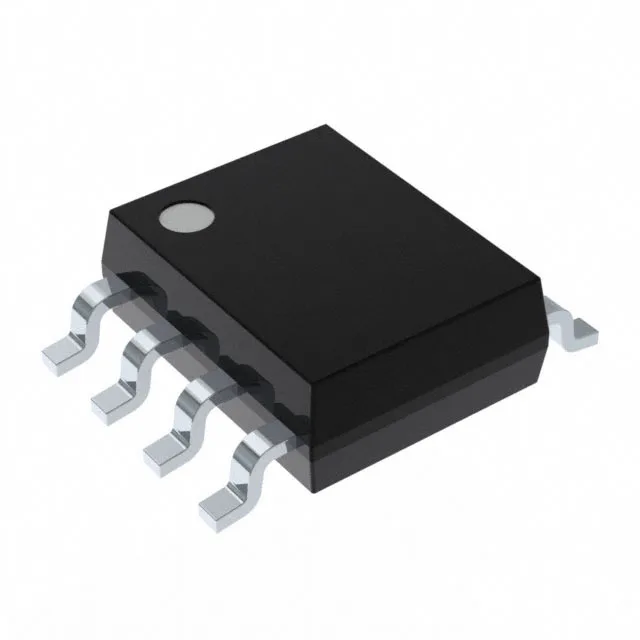
Packaged in an 8-SOIC (0.154-inch body width, 3.90 mm wide) — a standard surface-mount footprint that routes on a two-layer board without via fan-out. Operating temperature range is -40°C to +125°C, covering industrial, automotive under-hood, and high-temperature telecom environments. The 125°C ceiling means the reference can sit next to a hot processor or power stage without forced airflow, as long as the board's local ambient stays within that limit.