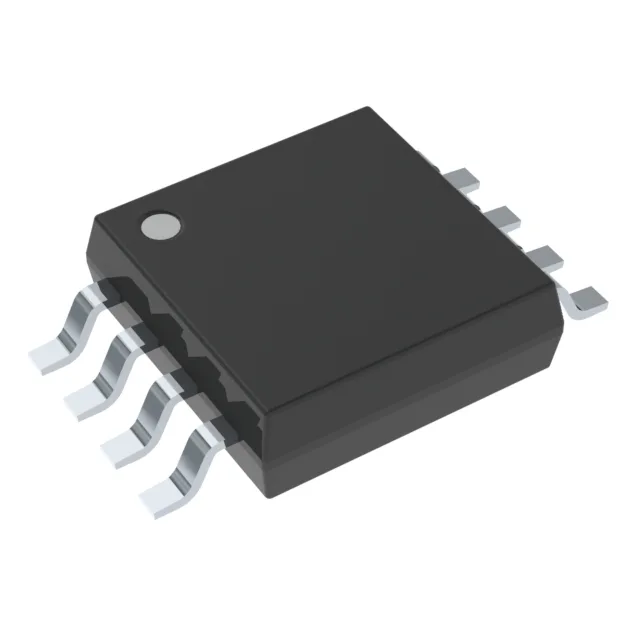
Precision voltage reference for ADC/DAC bias and sensor excitation
The MAX6126B25+T is a series voltage reference from Analog Devices, delivering a fixed 2.5 V output with an initial accuracy of ±0.1%. This precision suits it for biasing high-resolution ADCs or DACs where the reference voltage directly sets the full-scale range and the ±0.1% tolerance keeps the gain error within the system budget without external trimming. The series architecture means the output is regulated from the input rail (2.7 V to 12.6 V) and can source up to 10 mA. Unlike a shunt reference, the supply current (725 µA typical) does not flow through the load — the load current comes from the input, so the reference's own dissipation stays low even when driving a 10 mA burden.
Noise and drift: the specs that govern signal-chain accuracy
For a 16-bit ADC with a 2.5 V reference, this noise contributes roughly 0.2 LSB p-p — negligible for most industrial measurements, but worth budgeting in a 24-bit sigma-delta system where the reference noise floor can dominate the input-referred noise. The temperature coefficient is 12 ppm/°C. A system that calibrates at room temperature and operates across the full range should account for this drift in the error budget, especially for precision measurement or DAC voltage outputs.