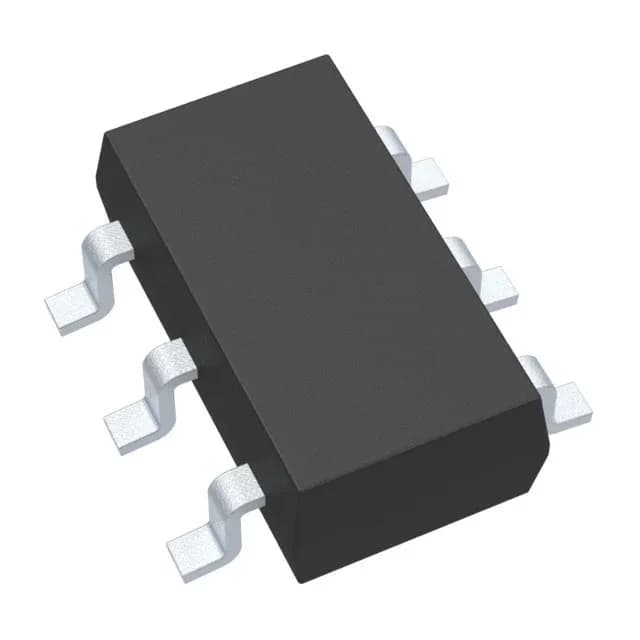
3.3 V fixed reference with ±0.08% initial accuracy
The MAX6070BAUT33+T is a precision series voltage reference from Analog Devices that outputs a fixed 3.3 V with an initial tolerance of ±0.08%. It operates from a 3.5 V to 5.5 V input rail and delivers up to 10 mA of output current. The reference is a series type, meaning it does not require an external resistor to set the output voltage — it behaves like a low-impedance voltage source that can both source and sink small currents. The SOT-23-6 package makes it a compact fit for space-constrained precision analog circuits such as ADC reference inputs, DAC voltage references, and sensor excitation.
8 ppm/°C drift keeps the output stable across temperature
The temperature coefficient is rated at 8 ppm/°C over the full -40°C to 125°C operating range. For a 3.3 V reference, this translates to roughly 26.4 µV of drift per degree Celsius. Over a 165°C span, the total drift stays within about 4.4 mV — well within the error budget for a 12-bit or even a 14-bit ADC system that uses the reference as its full-scale voltage. The wide temperature grade suits it for industrial control, automotive under-hood electronics, and outdoor telecom equipment where the ambient temperature swings significantly.
Noise: 10 µVp-p (0.1–10 Hz) and 6 µVrms (10 Hz–10 kHz)
Low-frequency noise is specified at 10 µVp-p over the 0.1 Hz to 10 Hz band, and 6 µVrms over the 10 Hz to 10 kHz range. These numbers matter when the reference feeds a high-resolution ADC or a sensitive analog front-end — the noise floor of the reference directly limits the signal-to-noise ratio of the conversion. A 10 µVp-p noise on a 3.3 V reference corresponds to roughly 3 ppm peak-to-peak, which is low enough for 16-bit systems without additional filtering. The 330 µA supply current keeps the self-heating and power dissipation low, which helps maintain the drift specification in a dense PCB layout.
Active lifecycle, no end-of-life risk
The ROHS3 compliance ensures it meets the latest environmental regulations for lead-free soldering and material restrictions. For a BOM line that requires a stable, long-life voltage reference, this part does not carry obsolescence risk — it can be specified into production without worrying about a sudden EOL notice.