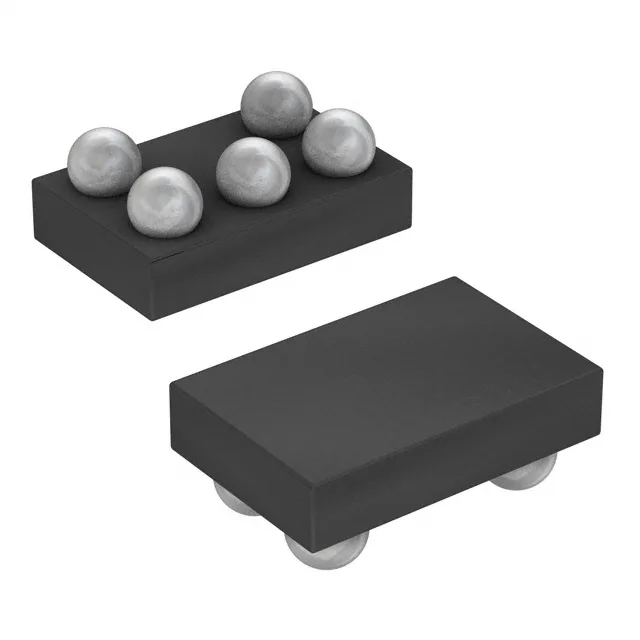
Precision 2.5V reference in a 1×1.52 mm BGA
The MAX6023EBT25+T is a series voltage reference from Analog Devices delivering a fixed 2.5 V output with ±0.2% initial tolerance. It operates from a 2.7 V to 12.6 V input rail and supplies up to 500 µA to the load. The 5-UCSP package (1.0 × 1.52 mm) is a wafer-level chip-scale BGA — the footprint matches the die, so the board layout must handle a 0.50 mm or finer pitch with via-in-pad for thermal and electrical connection to the inner planes.
Noise and drift — what the numbers mean for an ADC front-end
For a 16-bit ADC with a 2.5 V reference, the 125 µVrms noise contributes roughly 0.4 LSB of rms noise at the converter input — negligible for most industrial measurements but worth budgeting in a 24-bit sigma-delta system. The 30 ppm/°C temperature coefficient means the output drifts 75 µV over a 0°C to 85°C swing. That is about 0.003% of the 2.5 V output, well within the ±0.2% initial tolerance band for most precision analog chains. Supply current is 35 µA typical — low enough to keep the reference powered continuously in a battery-operated instrument without draining the cell during idle periods.
The series reference topology provides a stable output that does not require an external output capacitor for stability, simplifying the BOM.