10-bit dual DAC with I²C — what the specs mean for your BOM
The MAX5821MEUA+T is a 10-bit, dual-channel, voltage-output DAC from Analog Devices. It uses a string DAC architecture, which guarantees monotonicity — the output always moves in the correct direction as the digital code increments, critical for closed-loop trim applications where a non-monotonic step could cause oscillation. Each channel settles to within 0.5 LSB in 12 µs typical, driven by the I²C interface running at up to 400 kHz. For a calibration sequence updating 16 channels sequentially, that's under 200 µs per sweep — fast enough for production-line endpoint trimming but not for real-time waveform generation. The ±0.5 LSB max INL and DNL means the output voltage at any code is within one half of a least-significant bit of the ideal value. At 5 V reference, one LSB is 4.88 mV, so the absolute error stays within ±2.44 mV across the full range — no missing codes, no gain calibration needed in most 1% systems.
Package and board-fit — 8-uMAX/uSOP
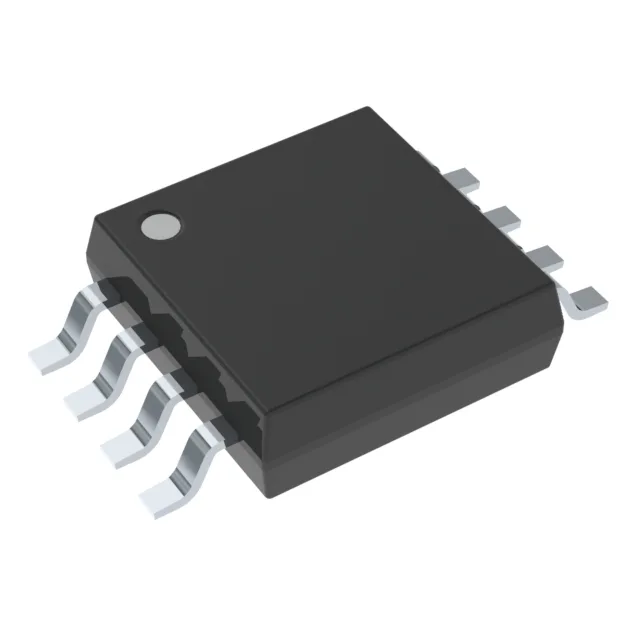
Housed in an 8-lead uMAX/uSOP package (3.00 mm body width, 0.118-inch pitch), the MAX5821MEUA+T occupies roughly 15 mm² of board area. The 0.65 mm lead pitch is two-layer-friendly — fan-out to a via or a bypass cap under the body is straightforward without micro-vias. An external voltage reference is required — the REF pin accepts any reference between VSS and VDD, and the output swing is rail-to-rail on the low end but limited to REF on the high side. The 8-uMAX package has an exposed pad on the bottom — soldering it to a PCB copper plane improves thermal conduction but is not required for the 0.5 mA quiescent current typical of this device.